
The way people find hotels has evolved fast. ChatGPT and Google AI are now part of how travelers decide where to book.
When someone types “best hotel near the airport with free breakfast,” AI provides them 3 to 5 hotel names. If your hotel is not on that list, that traveler will never find you.
This guide shows you how to get your hotel on ChatGPT and Google AI Search step by step. Every step is straightforward and actionable.
Why AI Search Is Different From Regular Google Search
Google shows millions of results. AI search shows only 3 to 5 hotels and stops there.
Getting pushed to page two on Google still gets you some visitors. Missing from an AI shortlist means zero bookings from that search.
AI does not just check one place. It looks at your website, Google listing, Online Travel Agency (OTA) profiles, and reviews altogether before deciding who to recommend.
How AI Decides Which Hotels to Recommend
AI does not guess. It looks for hotels whose information is clear, consistent, and easy to read.
If your data is messy or incomplete, AI skips your hotel and proceeds on to the next one. This happens in seconds.
The good news is that most hotels have not fixed this yet. Acting now puts you ahead of your competitors immediately.
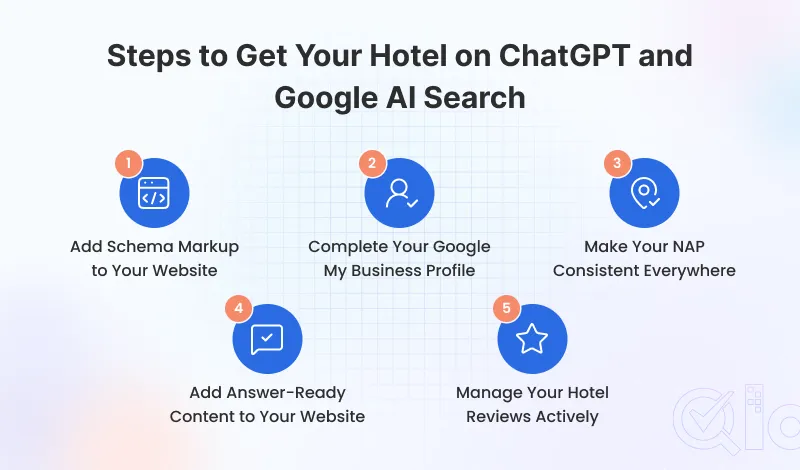
Step 1: Add Schema Markup to Your Hotel Website
Schema markup is code that tells AI exactly what your hotel is. It covers your name, address, star rating, check-in time, and amenities.
Hotels with complete schema markup are 2.1x more likely to appear in AI recommendations. Yet only 10.6% of hotel websites have good enough schema today.
This is the single biggest action you can take to get your hotel on ChatGPT and Google AI Search right now.
The Four Schema Types Your Hotel Needs
- Hotel Schema tells AI your property name, address, GPS location, price range, and star rating. Without it, AI cannot place your hotel on a map query.
- The FAQPage Schema gives AI direct answers to common traveler questions. Pages with an FAQ section are more likely to appear in Google AI Overviews.
- AggregateRating Schema shares your review score and total online review count with AI.
- ImageObject Schema helps AI read and understand your photos correctly.
How to Add Schema Without a Developer
Hotels using a Property Management System like QloApps usually have the schema handled for them. Ask support to confirm.
If you are on WordPress, an SEO plugin is the easiest way to sort your schema. It takes a few minutes, and no coding is needed.
Not on WordPress? Head to Google’s free Structured Data Markup Helper, grab the code, and paste it into your site header. Test it at search.google.com/test/rich-results when done.
Step 2: Complete Your Google My Business Profile
Your Google My Business Profile is one of the first places AI looks when forming hotel recommendations. An empty or outdated profile negatively impacts your chances.
Fill in every single field, including amenities, check-in times, price range, and phone number. Make sure your address matches your website exactly.
Upload at least 50 photos covering your rooms, dining area, lobby, and outdoor spaces. Google’s AI reads photo content to understand what your hotel offers.
Keep Your Profile Active Every Week
AI visibility drops for profiles that go inactive for 30 days. Post a weekly update covering a seasonal offer, a local event, or a guest highlight.
Use the Q&A section on your profile to answer common guest questions. Ask questions like “Is parking free?” and answer them yourself to get started.
An active, complete profile sends a strong trust signal to AI systems. It shows your hotel is worth recommending, and is a good practice for hotel reputation.
Step 3: Make Your NAP Consistent Everywhere
NAP stands for Name, Address, and Phone number. AI checks your information across multiple platforms before recommending your hotel.
If your name appears differently on Google, Booking.com, and TripAdvisor, AI loses confidence in your property. It will skip you and recommend a more consistent competitor.
Check every platform on which your hotel appears and fix any discrepancies. This costs nothing and takes just one focused afternoon.
Platforms to Audit Right Now
Start with your hotel website’s header, footer, and contact page. Then check your Google Business Profile and OTA platforms.
Also, check your social media profiles, pages, and any local tourism directories. Every listing must show the same name, address, and phone number.
A channel manager tool helps keep your hotel information consistent across all OTA listings automatically. It removes the risk of manual errors creating NAP mismatches.
Step 4: Write Answer-Ready Content on Your Website
AI cannot use vague marketing language. Phrases like “experience luxury in the heart of the city” give AI nothing useful to work with.
AI needs specific, factual answers to real traveler questions. Implement good Hotel SEO practices and answer exactly what guests ask before they arrive.
This kind of content is what gets your hotel on ChatGPT and Google AI Search for specific traveler queries. It is one of the most overlooked steps.
Make Your Room Pages Specific
Each room type needs its own page with at least 150 words of unique content. Include bed size, room dimensions, view type, bathroom features, and in-room amenities.
Do not copy the same description across all room types. AI notices duplicate content and treats it as low-quality information.
Specific room pages help AI match your hotel to searches like “hotel with bathtub” or “twin room near the city center”.
Build a Strong FAQ Page
Create a FAQ page covering parking, pets, breakfast, cancellation, check-in times, and airport distance. Write answers the way you would speak to a guest in person.
Then add the FAQPage schema to this page as covered in Step 1. This combination makes your FAQ page a powerful AI visibility tool.
Aim for at least 8 questions to start. Add more as guests ask new ones over time.
Step 5: Manage Your Hotel Reviews Actively
Reviews are not just for human guests anymore. AI reads your online reviews to decide how to describe and recommend your hotel.
Research shows that guest review signals drive the majority of AI-generated hotel recommendations. This makes your review strategy a direct AI ranking factor.
Strong, recent, and specific reviews across all platforms make it much easier for AI to find and recommend your hotel.
How to Get More Reviews
Use automated messaging to send a review request the moment a guest checks out. Keep it short and drop your Google review link right in the message.
Ask guests to mention what they actually liked: the rooftop, pool, breakfast, or location. The more specific the review, the more useful it is for AI to work with.
More reviews also mean more trust signals. AI favors hotels with a high volume of recent reviews over those with fewer older ones.
Respond to Every Single Review
Reply to every review within 24 hours, both positive and negative. AI reads your responses as a sign that your hotel is actively managed.
For negative reviews, acknowledge the issue and explain what you have done to fix it. Keep responses professional and brief.
A hotel that responds to reviews consistently ranks higher in AI recommendations than one that ignores them. This one habit makes a real difference.
Conclusion
Most hotels are still invisible on AI search. The ones showing up are simply the ones whose information is clear, consistent, and structured.
You do not need a big budget or a marketing agency to get your hotel on ChatGPT and Google AI Search. You just need to follow these five steps in order.
Start with your Google Business Profile this week. One step at a time is all it takes to get ahead of the majority of hotels that have done nothing yet.
Get in Touch
Ready to bring AI-powered booking to your hotel?
Let’s make it happen with QloApps – your all-in-one hotel management solution.
With QloApps, you can:
- Automate hotel operations easily
- Make bookings smarter and faster
- Improve guest satisfaction and service
QloApps is free to download and install on your system or server.
Need help? Reach out to the QloApps Support Team — we’re here to help you every step of the way.

Be the first to comment.