
Running a small property is hard work. Achieving small hotel growth takes consistent effort. You juggle guests, staff, pricing, and marketing every single day.
As your hotel grows, using the right hotel management software can make those daily tasks much easier.
Even hard-working hoteliers sometimes struggle to grow their business. In many cases, the problem isn’t a lack of effort.
Instead, a few common mistakes quietly limit bookings, revenue, and long-term growth.
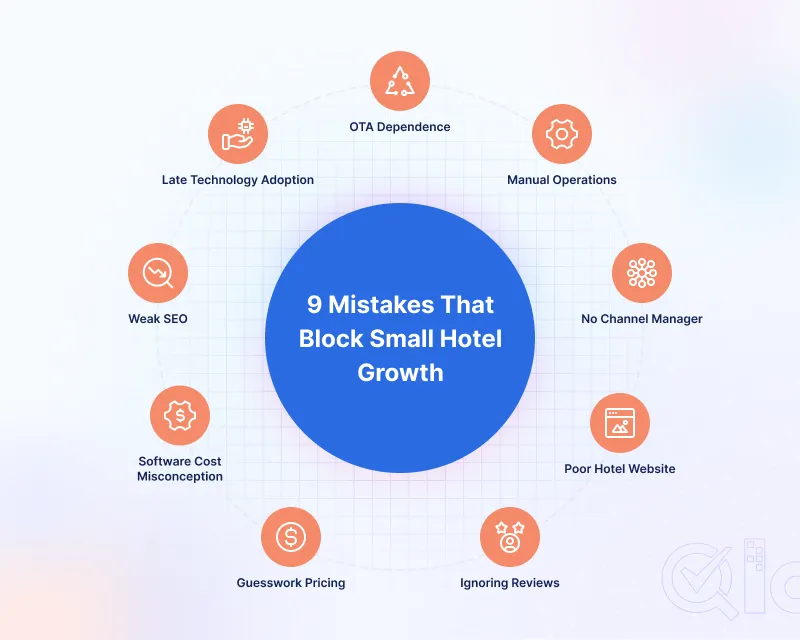
The good news is that most of these mistakes are easy to fix once you recognize them. Below are nine mistakes that often hold small hotels back and practical ways to overcome them.
1. Depending Too Heavily on OTAs
Online travel agencies bring visibility, but they also charge a commission on every booking. Over time, those fees can significantly reduce your profit margins.
However, if OTAs are your only booking source, your margins shrink fast.
The OTA also owns much of the guest relationship, making repeat direct bookings more difficult.
Hotels that rely too much on OTAs also have fewer opportunities to build guest loyalty.
Encouraging direct bookings through your own website helps reduce commission costs and gives guests a reason to book directly again.
Instead, a strong direct booking channel protects your profit. It also gives you more control over pricing and direct bookings.
2. Running Hotel Operations Without a PMS
Spreadsheets and paper logs work fine for a few rooms. They fall apart quickly once bookings increase.
As a result, manual processes cause double bookings, billing errors, and staff burnout. None of that helps your bottom line.
A dedicated property management system (PMS) centralizes reservations, housekeeping, and billing in one place.
In addition, it helps staff access guest information faster, reduce manual errors, and keep daily operations organized as the property grows.
3. Skipping a Channel Manager
Listing rooms on multiple OTAs while updating availability manually is risky. Even one missed update can lead to an overbooking.
That single mistake can cost you a guest and a bad review. Neither helps your reputation or your growth.
A channel manager automatically updates rates and room availability across every connected booking channel.
As a result, hotels reduce overbookings, save staff time, and keep inventory accurate across all sales channels.
In addition, a hotel channel manager keeps room availability synchronized. It also reduces the risk of overbookings.
4. Letting Your Hotel Website Fall Behind
Many small hotels treat their website as nothing more than a digital business card.
In fact, your website is often a guest’s first impression before they ever book a room. A slow or outdated site pushes them elsewhere.
Investing in a clean hotel website with a working booking engine pays for itself quickly.
In addition, a modern website builds trust and encourages direct bookings. Clear room details, updated photos, and a simple booking process give travelers the confidence to book directly.
5. Ignoring Online Reviews and Reputation
Most travelers check reviews before booking anything. Negative or unanswered reviews can cost more than a higher price ever would.
Small hotels often assume reputation management is only for big chains. In reality, it matters even more for independents.
Moreover, responding quickly and professionally builds trust.
Guests appreciate hotels that acknowledge feedback and resolve concerns. Positive responses also show future travelers that your hotel values customer service.
Over time, that steadily supports small hotel growth.
6. Making Pricing Decisions Without Data
Guesswork pricing is a common trap for small properties. Without occupancy or ADR data, smart decisions are nearly impossible.
Hotels that use analytics make sharper pricing and marketing calls.
As a result, hotels can improve revenue while supporting steady small hotel growth.
Instead, tracking booking trends, occupancy, and seasonal demand helps hotels make data-driven pricing decisions instead of relying on assumptions.
7. Assuming Good Hotel Software Costs Too Much
Many hoteliers delay adopting a PMS because they assume it’s built for big chains with big budgets.
That single assumption can stall small hotel growth for years. Open-source and free tools exist to remove this barrier.
Starting with affordable software allows small hotels to automate daily tasks without making a large upfront investment. As your hotel grows, the software can grow with your business.
Fortunately, open-source hotel management software helps automate daily work. It also scales as your business grows.
8. Build Small Hotel Growth with Better Marketing
Posting occasionally on social media isn’t a strategy. It rarely brings in new guests on its own.
Without basic SEO and local listings, small hotels stay invisible to travelers searching online right now.
Simple steps, like optimizing your site and updating your Google Business profile, lift direct traffic over time.
Publishing useful content, improving local search visibility, and keeping business information up to date also help more travelers discover your hotel online.
9. Support Small Hotel Growth with Early Technology Adoption
New hoteliers often delay tech decisions until problems force their hand. Missed bookings or complaints usually trigger the shift.
By then, switching systems costs more. Guest trust may already be damaged too.
Setting up the right tools early protects long-term small hotel growth.
Therefore, choosing the right hotel management software for new hotels early helps prevent operational problems as your business grows.
Conclusion
None of these mistakes are unusual. Most small hotels fall into a few simply because there’s rarely time to step back.
Fixing two or three, like adding a channel manager or upgrading your website, can noticeably speed up small hotel growth.
Ultimately, small improvements made today support long-term small hotel growth. The right technology and better daily operations help hotels stay competitive.
The fastest-growing properties don’t always have the biggest budgets. They just fix the fundamentals first.
Get in Touch
Looking for more than just a booking engine? Manage hotel operations, guests, and revenue from one platform with QloApps.
QloApps helps small hotels manage reservations, daily operations, guest experiences, and revenue from a single platform.
Have suggestions? Join the QloApps Forum and share your thoughts.

Be the first to comment.