OTA Ads vs Google Ads: What Works for Hotels?
Hotels have many ways to attract new guests in which two common options are OTA ads and Google Ads. Both channels can help generate bookings, but they work in different ways to reach travelers.
OTA ads help hotels gain greater visibility on online travel agencies, while Google Ads allows properties to reach travelers who are actively searching for accommodation.
Depending on the campaign, Google Ads can also direct potential guests to the hotel’s own website and booking engine.
So, which option should hotels use? There is no single answer. The right choice depends on the hotel’s goals, audience, budget, location, and booking strategy.

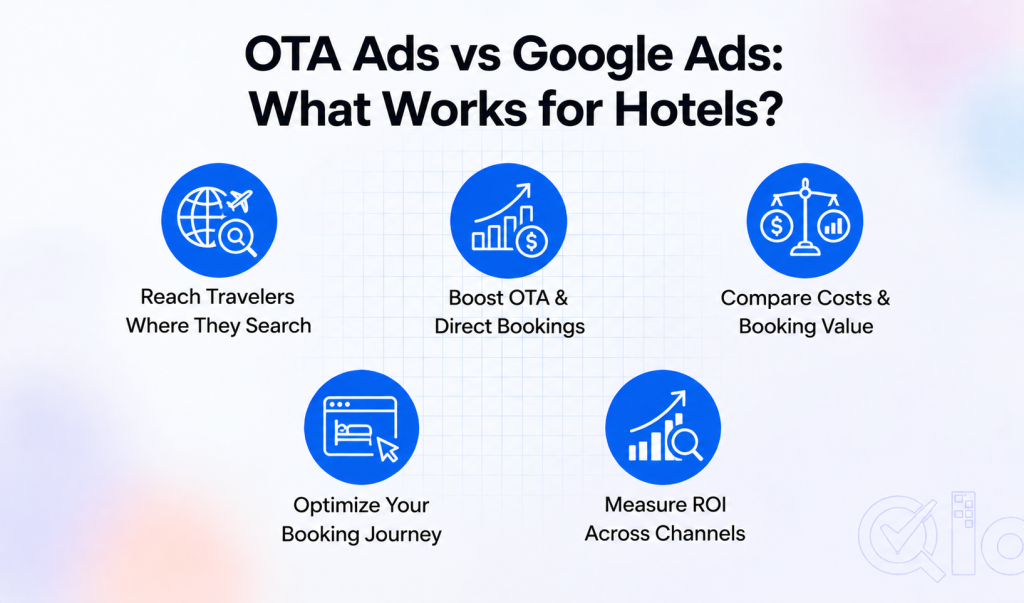
What Are OTA Ads?
OTA ads are paid promotional placements offered by online travel agencies such as Booking.com and Expedia. They help hotels appear more prominently when travelers search for rooms on an OTA platform.
For example, a hotel can use paid visibility to appear in front of travelers who are already comparing properties in a particular destination.
This can be useful when a hotel wants to:
- Increase visibility on an OTA
- Reach travelers who are ready to compare hotels
- Promote rooms during low-demand periods
- Improve exposure in competitive markets
- Generate more OTA bookings
The main benefit is access to an existing travel audience that is already looking for accommodation.
However, hotels should look at the total cost of each booking. Advertising costs can come in addition to OTA commissions, discounts, and other distribution costs.
Understanding OTA commission rates can help hotels calculate how much they actually earn from each reservation.
What Are Google Ads for Hotels?
Google Ads allows hotels to reach travelers while they search for accommodation on Google.
Hotel advertising can display useful information such as property details, room rates, availability, and booking links.
Google Ads can also direct travelers to the hotel’s website and booking engine. This gives the property more control over the booking journey and creates an opportunity to increase direct bookings.
The importance of Google Ads in hotel marketing is impeccable, hotels can use Google Ads to:
- Capture hotel-related searches
- Increase website traffic
- Generate direct booking opportunities
- Promote specific rooms or offers
- Reach travelers at different stages of their search
OTA Ads vs Google Ads: Key Differences
The main difference between the two channels is where travelers discover the property and where they continue their booking journey.
| Factor | OTA Ads | Google Ads |
|---|---|---|
| Main platform | OTA marketplace | |
| Audience | Travelers comparing hotels | Travelers searching online |
| Booking journey | Usually within the OTA | Can lead to hotel website |
| Main purpose | Increase OTA visibility | Capture search demand |
| Direct booking potential | More limited | Higher potential |
| Main competition | Other OTA listings | Other search results and advertisers |
Neither channel is automatically better for every hotel. Results depend on factors such as location, pricing, demand, campaign setup, and website performance.
When Should Hotels Use OTA Ads?
OTA advertising can be useful for hotels that already receive a large share of bookings through OTAs. Paid visibility can help these properties compete with other hotels on the same platform.
It can also benefit new or lesser-known hotels that have not yet built strong brand awareness or organic search visibility.
An OTA can provide access to travelers while the hotel builds its own online presence.
Hotels can also use OTA advertising during periods when demand is low. For example, a property may promote its rooms during weekdays, shoulder seasons, or other periods with fewer bookings.
However, hotels should not look only at the number of reservations generated. They should also consider commissions, discounts, advertising costs, and the final revenue from each booking.
A long-term strategy to reduce OTA dependency can help hotels increase direct bookings while continuing to use OTAs as part of their distribution strategy.
When Should Hotels Use Google Ads?
Google Ads can be useful for hotels that want to increase direct booking opportunities. Travelers may search for terms such as “hotels near Delhi Airport,” or “beach hotels in Goa.”
Some users may also search for a specific hotel by name. These searches can show a clear interest in a particular property or destination.
Hotels can use Google Ads to reach these users and direct them to their website or booking engine.
However, getting clicks does not guarantee bookings. The hotel’s website, room prices, offers, mobile experience, and booking process can all affect conversion rates.
Look Beyond Cost Per Click
Hotels should not judge an advertising campaign only by its cost per click. A low CPC does not always mean better results.
Instead, hotels should track the full customer journey and measure the value of the bookings generated.
Important metrics include:
- Cost per booking
- Conversion rate
- Revenue per booking
- Return on ad spend
- Average booking value
- Length of stay
- Cancellation rate
- Direct booking share
- Net revenue after advertising and distribution costs
For example, one campaign may generate more bookings but lower revenue per reservation. Another may generate fewer bookings but bring higher-value guests.
This is why hotels should compare channels based on net revenue and business goals, not only booking volume.
Your Booking Engine Matters
Advertising brings travelers to the hotel, but the booking experience can decide whether they complete the reservation.
A slow website, unclear room details, limited payment options, or a complicated checkout process can cause potential guests to leave.
The ideal booking journey should therefore remain simple:
Ad → Hotel Website → Room Selection → Booking Engine → Payment → Confirmation
A reliable hotel booking engine can help hotels turn advertising traffic into completed direct reservations.
The Role of a Channel Manager
Hotels that sell rooms through several OTAs also need to manage rates and availability across different channels.
For example, a property may receive bookings through Booking.com, Expedia, Agoda, Airbnb, and its own website.
Keeping room availability and rates updated across these channels can become difficult when done manually.
A Channel Manager can help synchronize room rates and inventory across connected channels, reducing the need for repeated manual updates and helping maintain consistent availability.
This creates a connected process:
Advertising → Booking → Channel Manager → PMS → Hotel Operations
Advertising creates demand, the booking engine captures reservations, the Channel Manager supports distribution, and the PMS helps manage daily hotel operations.
Should Hotels Use Both?
Hotels do not always need to choose between OTA Ads and Google Ads. Each channel can support a different part of the booking journey.
OTA ads can help hotels reach travelers who are already comparing properties on travel platforms.
Google Ads can help hotels reach people searching for accommodation and create direct booking opportunities.
The right mix depends on the property’s goals, audience, budget, market, and existing booking sources.
Hotels can test both channels with controlled budgets and track the results over time.
This makes it easier to understand which channel brings valuable bookings and where marketing spend should be adjusted.
Final Thoughts
OTA Ads and Google Ads serve different purposes in hotel marketing, so comparing them only by the number of bookings can give an incomplete picture.
OTA advertising can help properties gain visibility on established travel platforms, while Google Ads can help hotels reach travelers and create opportunities for direct bookings.
Hotels should look beyond clicks and booking numbers. The focus should be the value of each reservation after advertising costs, OTA commissions, discounts, and other distribution expenses..
A balanced strategy can combine OTA visibility, Google search, a strong booking engine, and efficient distribution tools.
By measuring results and improving the booking journey, hotels can make better use of their marketing budget and build a stronger direct booking strategy.
Get In Touch
Looking to improve your hotel’s booking and distribution strategy? Explore QloApps to manage direct bookings, OTA distribution, inventory, and hotel operations from one connected platform.
If you have any suggestions, you can share them on the QloApps forum. For any technical assistance, kindly raise a ticket.