
Hotel marketplace solutions offer hoteliers a practical way to grow beyond a single property without taking on the financial burden of acquiring new hotels.
Every hotelier I talk to eventually asks the same thing. How do I run more than one property without taking on debt to buy or build the next one?
It’s a fair question, because the traditional answer has always been expensive. Buy the land, fund the construction, hire a full staff, and repeat that process every time you want to grow.
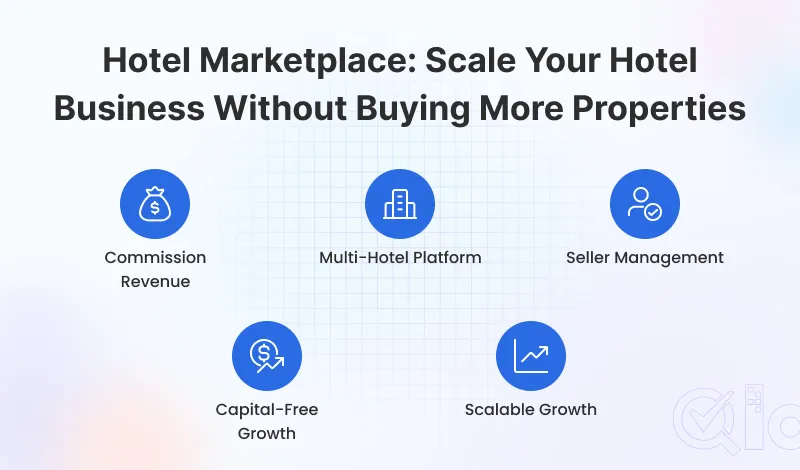
A hotel marketplace changes that equation completely. Instead of owning every property yourself, you let other hotel owners list on your platform while you earn commission on their bookings.
What A Hotel Marketplace Actually Means
A hotel marketplace turns your existing booking website into a platform other hotel owners can sell through. You’re no longer limited to the rooms you personally own.
This is different from QloApps default multi-property setup, which assumes one owner running several hotels through a single login.
A marketplace is built for the opposite case, where five different owners each want their property listed and you act as the platform admin.
The QloApps Marketplace Addon is what makes this possible without custom development work.
Why This Removes The Capital Problem
Buying a second hotel easily runs into six or seven figures once you include renovation and staffing costs. A marketplace needs none of that, because you’re not acquiring the property at all.
You’re providing the booking engine, the payment processing, and the guest traffic.
The property owners bring their own real estate, their own staff, and their own operations, while you earn a cut of every booking made through your site.
This is really the whole point. You grow your revenue and your footprint without your capital requirements growing alongside it.
How Sellers Get Onboarded To Your Platform
A new hotel owner creates an account and submits a request to join your marketplace. You review it and approve or reject the application before their property goes live.
Once approved, sellers manage their own room types, pricing, and availability from their own dashboard. You’re not involved in their daily operations at all.
Your job becomes approving new sellers and managing commission terms, not running someone else’s hotel. That’s a very different workload than owning the property yourself.
Setting Commission Rates That Actually Work
Commission is where your revenue actually comes from, so it’s worth getting right. Set it too high and owners will just keep their own direct booking site instead of joining yours.
Most owners I’ve seen start around 10 percent and adjust once real booking volume comes in.
You can also set different rates per seller, which matters once you’re working with properties of different sizes.
This is the mechanism that replaces property ownership as your growth engine. Every booking across every listed hotel earns you something, without you having funded any of those properties yourself.
Why Guests Trust A Multi-Property Site More
A website listing several hotels reads as more established than a single property page ever does.
I’ve seen conversion rates improve simply because guests expect more options and stay longer to browse.
That perception boost helps your own bookings too, not just your sellers’ listings. Guests land expecting a real platform, and that expectation works in your favor across every property shown.
Keeping Every Listed Property Actually Visible
None of this matters if guests can’t find the properties on OTAs where they’re actually searching. Each seller’s rates and availability still need to sync outward automatically.
A channel manager handles that sync so listings stay accurate across multiple channels. Skip this step, and even a well-built marketplace ends up with empty rooms nobody finds.
Starting Small And Scaling The Marketplace
You don’t need fifty sellers on day one to make this work. Start with two or three local hoteliers who don’t have strong booking sites of their own, and prove the model with them first.
Once a few properties are live and earning, referrals tend to bring more sellers in naturally.
Owners see a working marketplace and want to join, especially once they hear commissions are reasonable and onboarding is simple.
Conclusion
Launching multiple properties without huge capital used to sound like wishful thinking.
A hotel marketplace makes it realistic, because you’re earning from properties you never had to buy, build, or staff.
You still need the right systems running underneath it, from commission tracking to OTA sync, but none of that requires the capital a second hotel would.
For most independent owners, this is simply the more achievable path to running more than one property.
Get in Touch
If this model fits where your hotel business is headed, QloApps makes the setup manageable.
The QloApps Marketplace Addon is a one-time purchase and is installed directly on your existing QloApps setup.
You can download QloApps for free and test it against your own growth plans.
Our support team is ready to help if you run into setup questions.

Be the first to comment.