Hotel Profit Margins 2026: Where Money Is Made
A full hotel does not always mean a profitable one, and 2026 is proving that fast. Hotel profit margins now depend far more on cost control than on room count alone.
Revenue can climb while margins quietly shrink underneath it. Hotel profit margins fall when costs like labor and energy grow faster than the income covering them.
This guide breaks down where hotel profit margins actually come from this year. It also shows where most properties are losing money without realizing it.
Why Revenue Growth No Longer Guarantees Profit
Hotels have chased RevPAR for years as the main sign of success. Strong ADR and RevPAR numbers can still hide a shrinking bottom line.
Labor costs, distribution fees, and energy prices have all climbed faster than room revenue. Hotel profit margins reflect this gap between what comes in and what goes right back out.
Occupancy alone tells only part of the story here. A hotel running near full capacity can still post weak margins if every extra guest costs almost as much to serve.

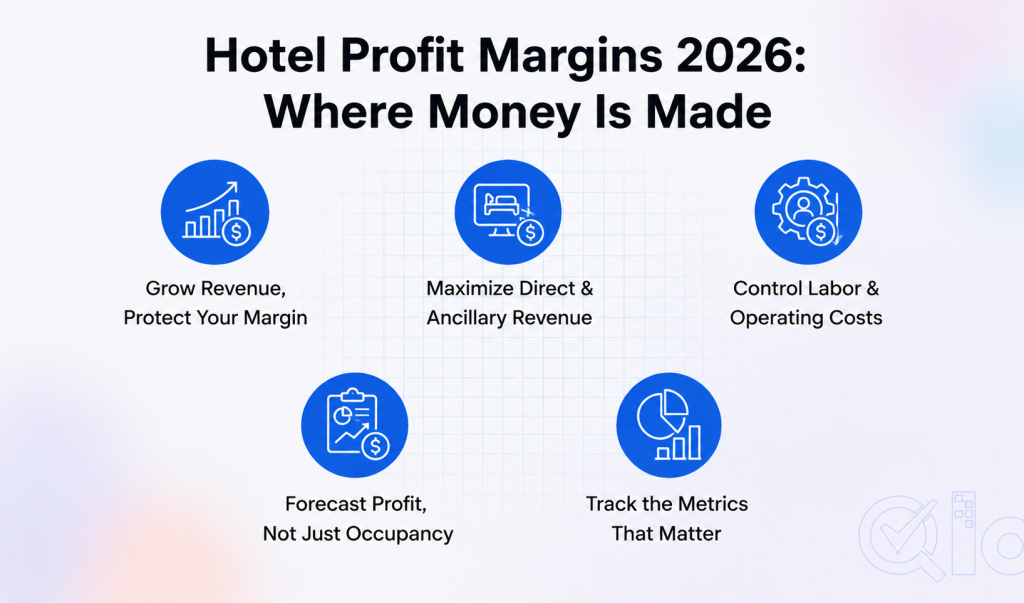
Where Hotel Profit Margins Actually Come From
Room revenue still forms the base of most hotel income, but rarely the full profit picture. Food, beverage, spa, and parking often carry higher margins than rooms themselves.
Direct bookings protect margin in a way OTA bookings simply cannot match. Every commission paid to a third party is money that never reaches the bottom line at all.
Reviewing hotel revenue reports shows which segments perform best. Some sources look busy but quietly drain profit.
Rate strategy also plays a bigger role in margin than most owners assume. Rate increases tend to flow through to profit far better than occupancy increases do.
The Cost Side Hotels Often Ignore
Labor remains the largest controllable cost on most hotel books today. Scheduling based on real, forecasted demand keeps this cost from quietly creeping upward.
Energy and utility costs have become a much bigger factor in recent years. Small operational choices, from lighting to HVAC scheduling, now show up clearly in year-end margins.
Maintenance and repair costs often get underestimated until they hit the books all at once. A steady, planned approach beats reacting to breakdowns after they already cost more.
How Forecasting Protects Margin, Not Just Revenue
Forecasting used to focus mainly on predicting occupancy ahead. Strong demand forecasting now needs to connect that picture to real cost data.
This shift matters because occupancy alone no longer explains profitability the way it once did. Hotel profit margins depend on knowing what each extra booking actually costs to fulfill.
AI tools are making this kind of forecasting more accessible. Reviewing AI-driven forecasting shows how teams catch margin risk earlier.
Budgeting With Margin in Mind
A budget built only around revenue targets misses half the real picture. Hotel profit margins should sit at the center of any serious annual budgeting process.
Building flexibility into cost lines matters more this year. See inflation-proofing a hotel budget for how to plan ahead.
Setting a monthly review habit catches margin erosion before it becomes a year-end surprise. Waiting until annual reports arrive is often too late to fix the real cause.
Technology’s Role in Protecting Margin
Manual systems make it hard to see cost and revenue in one view. A connected property management system pulls both sides together automatically.
This visibility lets teams catch a slipping margin days after it starts, not months later. Small corrections made early cost far less than large ones made in a panic.
Automated reporting also frees up staff time that would otherwise go into manual spreadsheet work. That time is often better spent analyzing why a margin moved, not just recording that it did.
Key Metrics That Reveal Real Margin
RevPAR alone rarely tells hoteliers where profit is actually being made or lost. GOPPAR, or gross operating profit per available room, cuts much closer to the real number.
Tracking labor cost per available room shows how efficiently staffing turns into service without waste. This single metric often explains more about hotel profit margins than occupancy ever could.
Guest acquisition cost also deserves close attention alongside these other numbers. A booking that costs too much to acquire can quietly erase the margin it was supposed to create.
Final Thoughts
Hotel profit margins in 2026 are being made and lost in the details, not the headline numbers. Occupancy and RevPAR still matter, but they no longer tell the whole story alone.
Hotels that track cost as closely as revenue protect their margins better than most. Rate strategy, labor efficiency, and direct bookings shape the final number more than owners often assume.
Building that habit now, reviewing costs monthly and forecasting with margin in mind, sets up a stronger year ahead. Properties that master this early hold profits steady as costs shift.
Get In Touch
Looking to build a more profitable and efficient hotel operation? Get in touch with the QloApps team to explore solutions that help you manage bookings, and business operations from one place.
If you have any suggestions, you can share them on the QloApps forum. For any technical assistance, kindly raise a ticket.