
Empty rooms are not what hurts hotel profits. Getting caught off guard by a rush does, and hotel demand forecasting cures that.
It tells you who will book and when. We’ve kept this guide simple so you can master the strategy, even if you’re new to the job.
What Is Hotel Demand Forecasting
This process predicts future room bookings by tracking historical data, market trends, and local events to see what’s coming.
Teams use these insights to anticipate occupancy rates and revenue. It essentially guides your operations so everyone can plan.
These outlooks scale across different timelines. You can map out the next few days or look ahead at an entire season or year.
Why Hotel Demand Forecasting Matters for Revenue Management
Whether you use dynamic pricing or manual pricing, both rely on hotel demand forecasting. A rush means higher prices; a quiet week means deals.
This logic keeps your revenue steady no matter the season. It also dictates your staffing schedules, like bringing in extra housekeeping for busy weekends ahead.
Marketing budgets follow the same rhythm. Slow season gets that extra ad push, while peak season sells out on its own.
Bad math costs real money. You end up underpricing a massive event and dropping profit, or overstaffing an empty property and wasting wages.
Types of Hotel Demand Forecasting
Properties don’t rely on a single outlook when it comes to hotel demand forecasting, since each department needs its own clear view of what lies ahead for the business.
Operational forecasts
This short-term outlook helps ground teams prepare. It tells the front desk and housekeeping exactly how busy the shifts will be.
Financial forecasts
Looking much further out, these models project total revenue and operating expenses for the upcoming month or quarter.
Pricing forecasts
Offering the deepest level of detail. This specific data guides your daily room rates and inventory availability choices.
Most managers blend all three. They might review long-term finance reports monthly, but tweak room pricing every single morning.
Key Data Sources for Hotel Demand Forecasting
Accurate hotel demand forecasting always needs reliable data to work well. Properties pull these insights from two distinct primary channels available to them.
Internal Data
Your property management system (PMS) stores internal data. This is where past occupancy numbers and daily room rates live.
Booking pace and guest segments are equally critical. Tracking these habits helps you see how fast rooms fill compared to last year.
External Data
External conditions matter too since properties don’t exist in a bubble. Competitor rates show what options guests have.
Nearby events, local weather, flight paths, and sudden spikes in online search volume all signal shifts in incoming booking demand.
Why Data Quality Affects Forecast Accuracy
Flawed data ruins your forecast, regardless of how smart your method is. Outdated records and missing entries are common culprits.
Keeping your hotel metrics data and tracking sheets clean matters immensely. A simple habit of daily updates prevents the vast majority of errors.
Hotel Demand Forecasting Methods
With your data ready, you need a system to translate those metrics into projections. Methods range from basic math to automated models.
Basic Forecasting Methods
Basic methods focus on the fundamentals. They look backward at last year’s performance and track how fast current rooms are filling up.
These strategies also map outside factors like pricing. They work best by aligning your forecast with distinct guest personas.
Advanced Forecasting Methods
Advanced methods rely heavily on automation. Machine learning models instantly process years of complex booking habits simultaneously.
These systems adapt in real time as new reservations come in. While basic tools fit boutique stays, large resorts need this scale.
How to Forecast Hotel Demand: Step-by-Step Process
A structured process ensures your property gets reliable numbers every single time. Follow these five clear steps to build your next property forecast.
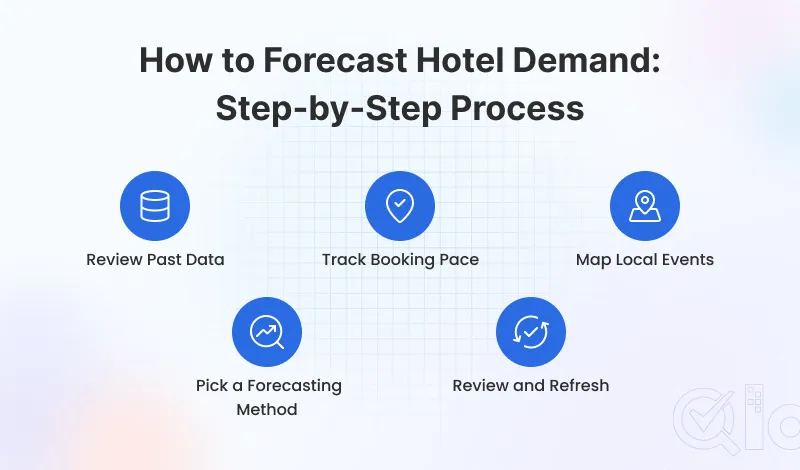
Step 1: Review past data
Grab booking numbers from the last one to three full years of hotel operations. This gives you a solid baseline of what a typical season usually looks like.
Step 2: Track Booking Pace
Compare today’s reservation velocity against the exact same week from last year’s calendar. Are you filling up faster than before, or slower this time around?
Step 3: Map local events
Plan ahead for the upcoming holidays, festivals, and business conferences already on the calendar. These local variables can shake up your occupancy overnight.
Step 4: Choose your method
Match your forecasting method carefully to your hotel’s actual size and its specific operational needs. A 50-room boutique shouldn’t use a massive resort’s playbook.
Step 5: Review and Refresh
See how your guess matched reality once the weekend finally passes by. Tweak your numbers weekly, using key front desk KPIs to keep every forecast fresh and accurate.
A Simple Forecasting Example
Numbers make hotel demand forecasting easier to picture. Say a 100-room hotel had 80 percent occupancy last year during this same week.
Right now, your current pace already shows 60 reservations. On top of that, a local festival is drawing 10% more visitors to town this round.
Based on this pickup pace, you can forecast a 90 percent occupancy rate. That means 90 rooms booked for the week instead of last year’s 80.
With that insight, management can confidently optimize their strategies to grow hotel revenue. They can also schedule extra housekeeping staff for the rush.
What Influences Hotel Demand? Common Demand Drivers
Demand does not move on its own. Certain forces push it up or pull it down through the year.
- Seasonality and school holidays: Families travel when schools close, creating predictable peak season waves.
- Local events and festivals: Weddings, conferences, and big concerts boost occupancy rates and demand.
- Economic conditions: People travel less when budgets are tight, so this shifts demand quietly over time.
- Competitor pricing shifts: Guests compare rates before they book, so a rival’s price change can nudge your own demand.
These drivers vary by city and property type. Track which ones affect your specific market most.
Common Hotel Demand Forecasting Mistakes and Best Practices
Even seasoned revenue teams stumble into a few repeated errors when predicting market demand. A few simple habits fix most of them.
- Set a Fixed Schedule: Forecasts grow stale fast, so update your models weekly and review them daily if your property is highly active.
- Blend Your Signals: Relying only on last year’s history isn’t enough. Combine internal booking velocity with outside data like regional festivals.
- Segment Your Guests: Treating every guest type the same erases the sharp details that make forecasts accurate, so track traveler types individually.
- Audit the Variances: Compare your projections against actual stays often, and adjust your math when the gaps widen.
- Prioritize Data Hygiene: Keep records clean across every system. Ditch messy logs and migrate from spreadsheets to a hotel PMS to keep records clean.
- Working in an Isolation Bubble: Your property always competes within a wider market, so ignoring local rivals always skews the math.
Demand Forecasting Software and Tools for Hotels
While manual tracking works for smaller stays, hotel demand forecasting software becomes vital as operations grow. Great tools pull hotel metrics straight from your PMS.
Prioritize systems that break down guest types and monitor pickup speeds. Top platforms will also automatically flag sudden market shifts.
Note that standalone forecasting tools purely predict future demand. Full revenue management systems take that data and set pricing for you.
Both options serve distinct roles based on your scale. Many modern PMS even include basic prediction features built right in.
Conclusion
Hotel demand forecasting turns guesswork into a habit you can rely on. It touches pricing, staffing, and marketing all at once.
Treat it as an ongoing practice rather than a task you finish once. Hotels that check their numbers often stay a step ahead of demand.
Get In Touch
Ready to put hotel demand forecasting to work? QloApps gives you the tools to manage your property from day one.
Download QloApps for free and add your property in minutes. Setup takes just a few steps.
Have a suggestion? Share it on the QloApps forum. Need help? Raise a support ticket anytime.

Be the first to comment.