
Local community tourism is the untapped revenue opportunity helping hotels grow beyond stagnant room rates, rising OTA commissions, and price wars.
Small properties are pulling in real income just by linking guests to the neighborhood around them. It really comes down to rethinking what your location already has to offer.
And this isn’t some fad that’ll fade out next year. Travel habits have shifted for good, and hotels that ignore this are watching bookings walk straight to competitors who figured it out first.
What Guests Are Actually Booking For
Nobody books a hotel anymore just because the sheets are clean and the breakfast is decent. Travelers want something worth telling their friends about once they’re back home.
Put two hotels side by side at the same price point, and guests will pick the one that feels rooted in something real over the one bragging about amenities.
That’s precisely why properties folding how hotels share local stories into their brand end up converting better than places selling plain convenience.
Instead of racing competitors to the bottom on price, you’re selling something guests actually remember, and that’s a far easier fight to win with local community tourism.
Smaller guesthouses regularly beat bigger hotels down the street purely because they tell a sharper story about their area.
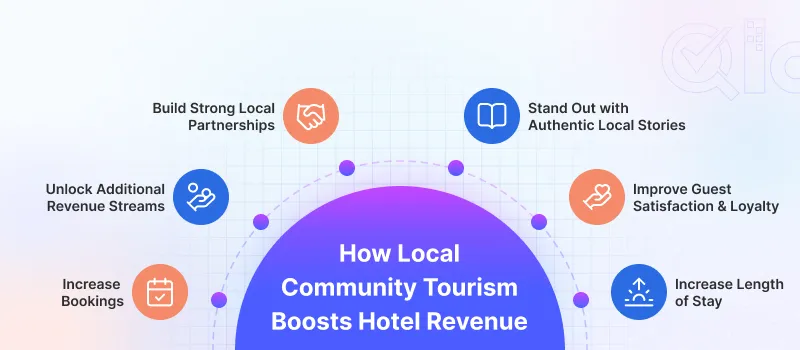
Where the Extra Revenue Actually Comes From
A plain room booking only stretches so far, there’s a ceiling on what four walls and a bed can earn.
Tack on a cooking class, a heritage walk, or a craft workshop, and suddenly there’s something on offer that the hotel across the street simply doesn’t have.
Properties running these bundles routinely see stays stretch from three nights to five, once there’s enough happening locally to keep guests occupied.
Guests also loosen their spending considerably once they feel genuinely tied to a place.
Someone who spent the morning with a local potter is a lot more likely to say yes to that evening boat ride without much persuasion needed.
Even modest commissions pile up fast once a property is running several packages weekly. By season’s end, that side income often covers costs the room rate alone was never designed to handle.
Your Location Is Already Doing the Selling
Every hotel sits near something worth mentioning, a spice market, a weaving village, a heritage lane, a beach shack famous for its curry.
Most owners never bother putting any of local community tourism spot it on their website, which is honestly baffling once you start noticing it.
That gap costs money, because local attractions can market hotels and increase conversions far more reliably than another round of paid ads ever will.
A simple “what’s nearby” page with honest, unpolished photos can lift bookings without spending a single rupee.
Guests want proof a destination is worth their trip before they commit their money.
This tiny addition often outperforms a full month of ad spend, and it costs nothing beyond a bit of writing and a few decent photos.
A slightly rough photo of an actual local market beats a polished tourist-brochure shot almost every time, since people can spot the difference in seconds.
Turning Neighbors Into Genuine Partners
The fastest entry point into local community tourism is partnering with local artists and shopkeepers working near the property.
A lobby exhibit of local craftwork, a weekend workshop, or a dish sourced from a family kitchen gives guests something worth photographing.
What small property deliver instead is authenticity, something a large chain with a massive marketing budget still can’t manufacture convincingly.
One solid relationship is genuinely enough to get things moving. Word spreads fast among guests, and soon they’re requesting “that potter” or “that walking guide” specifically by name.
Over time these small local ties become woven into a property’s identity. Guests eventually choose a hotel specifically because of what it’s built with the people around it.
Your Booking System Has to Keep Pace
Most of this collapses fast if the booking software can’t bundle a room together with an add-on experience, leaving staff stuck patching things together with spreadsheets and sticky notes.
These workarounds feel manageable for a week or two, then it quietly starts eating hours nobody has to spare.
Front desk staff need one clear place to check who booked what, especially if a property is running more than a handful of packages monthly.
Manual tracking holds up fine at small scale, then falls apart the moment volume picks up.
Get the system sorted, and local partnerships more or less start running on their own momentum. Even the strongest local ideas turn messy at check-in, something guests notice almost instantly.
Conclusion
Local community tourism remains one of the rare growth levers that doesn’t require a bigger ad budget or another price war with the competition.
Properties leading this shift didn’t start with grand plans, they picked one local partner and one experience, then built outward from there.
Get In Touch
If you’re ready to package local experiences into your bookings, your software needs to keep pace with your ideas.
QloApps lets you build custom packages, manage add-ons, and run your entire property from one simple dashboard.
You can download QloApps for free and have it running on your property within a day.
If you run into any issues, our support team is ready to help for more hospitality insights and hotel management resources anytime.

Be the first to comment.