
Plenty of visitors land on your website every day, yet the booking numbers barely move. This situation is more common than most hotel owners realize.
High website traffic but few hotel bookings usually means something is stopping guests between clicking your website and confirming a reservation.
The good news is that this problem is almost always fixable once you know where to look, and it rarely requires a bigger marketing budget.
Instead of chasing more website traffic, focus on improving your hotel booking conversion rate to turn more visitors into confirmed bookings.
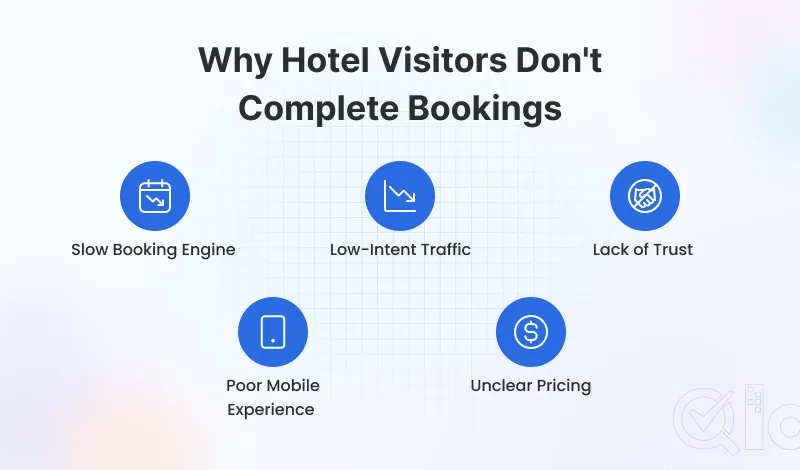
Why High Website Traffic Doesn’t Always Lead to Hotel Bookings
High website traffic may look impressive, but it only matters if it leads to bookings and revenue.
In fact, a visitor browsing your gallery isn’t the same as a visitor comparing dates and rates with intent to book.
So when a hotel sees high website traffic but few hotel bookings, the real question isn’t how to get more visitors. It’s why the ones already there aren’t converting.
That shift in thinking changes where you should be spending time and budget next.
Fix a Confusing or Slow Booking Engine
The booking engine is where most lost reservations actually happen, often silently, without anyone noticing until the numbers are reviewed.
It’s one of the biggest hidden causes of high website traffic but few hotel bookings.
If guests need too many clicks to check availability, many will simply abandon the booking and choose another hotel instead.
Reducing the number of booking steps makes it easier for guests to complete a reservation.
Showing clear pricing at every step also encourages more guests to complete their bookings.
Speed matters just as much as simplicity here, since a booking engine that loads slowly loses guests before they even reach checkout.
Choosing the right booking engine from the start can also reduce unnecessary friction during checkout.
Attract Guests Who Are Ready to Book
Not all traffic is created equal, and this is often exactly where high website traffic but few hotel bookings starts to make sense.
A visitor arriving through a generic keyword rarely has the same booking intent as one who searched for your exact location and dates.
Room pages, amenity pages, and local attraction content tend to attract guests who are actively comparing their options.
Build Trust With Reviews and Transparent Pricing
Guests hesitate to book when something feels uncertain, whether that’s unclear pricing, no visible reviews, or a website that looks outdated.
Trust gaps like these are a common reason hotels see high website traffic but few bookings.
Displaying real guest testimonials and reviews directly on your site helps build trust.
It reassures hesitant visitors before they even reach the booking engine itself.
Pricing transparency matters just as much. Hidden fees revealed late in the process are one of the most common reasons guests abandon a booking entirely.
Showing the full rate upfront, including taxes, tends to build more trust than a lower headline price that changes at checkout.
Optimize the Experience for Mobile Guests
A large share of hotel website visitors now arrive on a phone, and their experience is often worse than the desktop version.
If buttons are hard to tap, forms are difficult to fill out, or pages load slowly, mobile visitors abandon the process at a much higher rate.
This gap alone can explain why a hotel sees high website traffic but few hotel bookings, since desktop numbers may look fine while mobile is quietly failing.
Testing your booking flow on an actual phone, not just a browser resize, usually reveals friction points that would otherwise go unnoticed.
Hotels can further improve mobile bookings by learning how to target mobile travelers.
Identify Where Guests Abandon the Booking Process
Without tracking, it’s nearly impossible to know where visitors leave before completing a reservation.
Setting up basic funnel tracking through your booking engine shows precisely which step causes the most guests to abandon.
Once you’ve identified where guests leave the booking process, you can also retarget abandoned hotel bookings to recover reservations that might otherwise be lost.
This single habit, reviewed monthly rather than occasionally, tends to produce the most consistent gains in actual booking numbers over time.
Pairing this with a well-designed hotel website built for conversions tends to compound the results even further.
Conclusion
High website traffic but few hotel bookings is rarely caused by a single issue. It’s usually a combination of small frictions adding up across the guest journey.
Fixing the booking engine, attracting qualified traffic, building trust, and improving the mobile experience all work together to increase bookings over time.
Start with the step where guests are dropping off most, since that single fix often produces the clearest and fastest improvement in bookings.
Get in Touch
Looking for an easier way to manage bookings while creating better guest experiences? QloApps can help.
QloApps helps hotels manage reservations, booking engines, guest experiences, and daily operations from a single platform.
Have suggestions? Join the QloApps Forum and share your thoughts.

Be the first to comment.