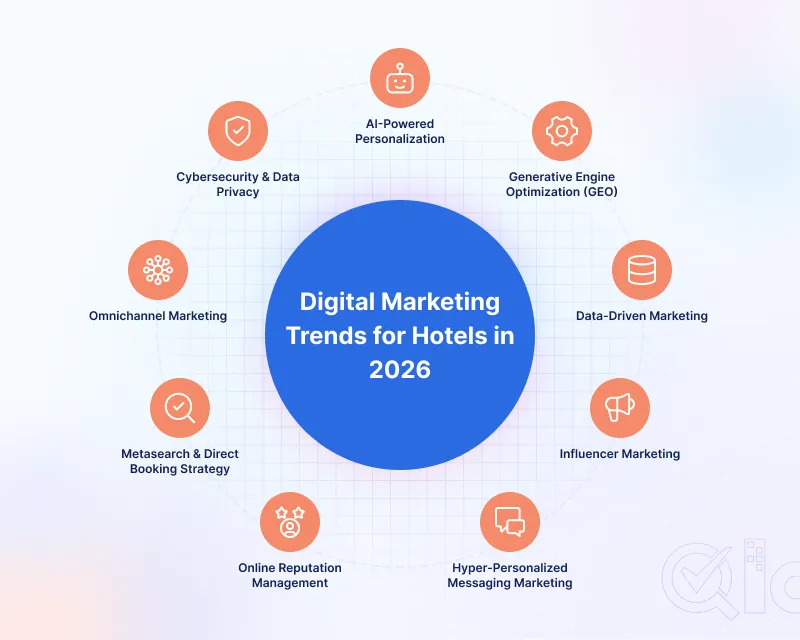
9 Digital Marketing Trends for Hotels in 2026
Digital marketing trends for hotels are shifting in ways that actually work in your favour. Now is the best time to get ahead of them.
Before a guest books your hotel, they have already asked ChatGPT, watched a TikTok, and checked your Instagram. Being visible across all of these is now a real advantage.
2026 is a different playing field for hotel marketing, and that is actually good news. The hotels that adapt now have a real head start over those that have not moved yet.

1. AI-Powered Personalization
A guest who feels genuinely looked after will come back. One who feels like just another booking usually will not.
AI uses past booking data to send offers that actually make sense. A business traveler and a couple on their anniversary get very different messages.
That kind of personalization in hotel experience is what turns a one-time guest into a repeat customer.
2. Generative Engine Optimization (GEO)
More travelers are asking ChatGPT things like “best hotels near the old city with free parking.” Whatever comes up first is where they book.
If your hotel is not in those answers, you are invisible to ready-to-book travelers. Getting Hotels on ChatGPT and AI Search right matters.
A detailed FAQ page and accurate listings across all platforms are where you start. Most hotels have not touched this yet, which works in your favor.
3. Data-Driven Marketing
Third-party cookies are fading out, and that is actually good news for hotels that collect their own guest data.
Direct bookings and website behavior tell you exactly who your guests are. A good business analytics turns that into smarter marketing decisions.
Knowing your audience is one of the core digital marketing trends for hotels that pays off fastest. You spend less, reach more of the right people, and get better results.
4. Short-Form Video, UGC & Influencer Marketing
Some of the best hotel marketing this year is coming from guests, not marketing teams. A single 20-30 second clip can reach more people than a paid campaign.
Real guest videos and photos carry far more trust than branded content ever will. This is the reality of short-form video and UGC in 2026.
A niche travel creator with 10,000 followers who trust them will do more for your hotel than a celebrity with a million who do not. A good influencer marketing strategy starts there.
5. Hyper-Personalized Email & WhatsApp Marketing
Most hotel emails never get opened. Guests respond to messages that speak to them directly, not ones that feel like a bulk send.
Group your guests by travel purpose and booking history. Set up automated messaging for every phase of the guest journey.
A WhatsApp message wishing a guest happy birthday or happy anniversary feels personal in a way that email never quite does.
6. Online Reputation Management
No marketing copy, paid ad, or fancy website sells your hotel better than a guest who had a great stay and wrote about it honestly. Most travelers book based on what they read.
Getting more positive reviews is not complicated. A simple message after checkout with a direct review link is often all it takes.
When a bad review gets posted, respond to it. A calm reply to online reviews shows future guests your hotel takes feedback seriously.
7. Metasearch & Direct Booking Strategy
Hotel metasearch puts you in front of travelers who are ready to book. It shows your rates right next to every competitor.
Keeping your rates updated and competitive on these platforms matters. Give guests a real reason to book directly with you instead.
Free breakfast or a room upgrade for direct bookers can shift that decision your way. Reducing OTA dependency is one of the digital marketing trends for hotels that directly improves margins.
8. Omnichannel Marketing
Nobody books a hotel after seeing it just once. They will check your Instagram, then your website, then Google your reviews before they even think about entering card details.
Most hotels lose bookings because of mixed signals online. A guest who sees conflicting information across platforms will just move on.
A channel manager keeps your rates and availability consistent across every platform. That alone removes a lot of the confusion that costs hotels bookings.
9. Cybersecurity & Data Privacy
Guests hand over a lot when they book online. Card numbers, personal details, and sometimes even passport information.
A data breach in the hotel industry does not just cost money. It can wipe out years of guest trust in one incident.
Governments have data protection guidelines, and hotels must follow them. SSL encryption and compliance are part of running a property that guests can trust.
Conclusion
Most of what works across these digital marketing trends for hotels comes down to one thing. Make every guest feel like you actually know them, and you are halfway there.
Start with two or three of these trends and do them properly. Half measures across all nine will get you nowhere fast.
Big budgets do not guarantee full rooms. The hotels doing well in 2026 are simply the ones that understand their guests and market accordingly.
Get In Touch
Want to streamline your property operations and build a strong online presence? QloApps is ready to assist!
With QloApps’ Property Management System and Channel Manager, you can effortlessly manage your property and boost your revenue. So, contact us today!
To get started with this user-friendly software. Just download it and add your property to QloApps.
If you have any suggestions, you can share them on the QloApps forum. For any technical assistance, kindly raise a ticket.