Smart Pricing: The Psychology Behind Hotel Rates
Hotel Smart pricing is not just a number you put on a booking page and leave there. It is the first thing guests react to before they look at your rooms.
Most hotels treat pricing like a math problem, such as cover costs, check the competition, tweak for the season and then wonder why bookings stay flat.
The real issue of pricing is that guests do not respond to numbers the way hotel owners expect them to.
The psychology behind hotel rates is what actually drives bookings, and this article breaks that down in a way you can act on today.

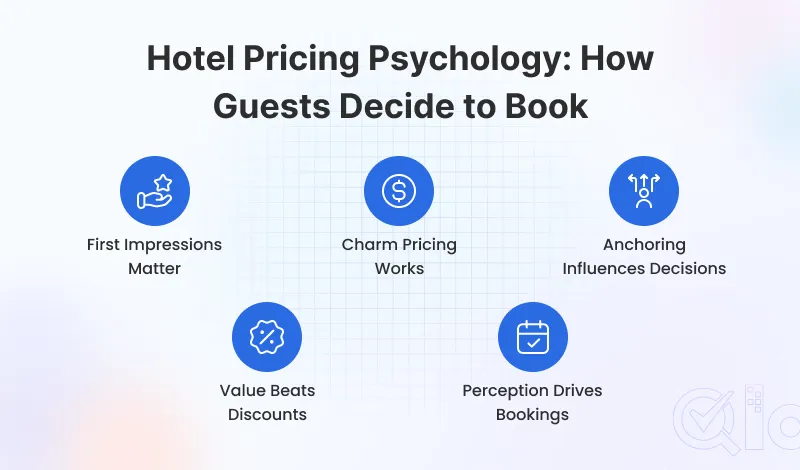
Understanding Smart Pricing: What It Means and Why It Matters for Your Hotel
Smart pricing is not about squeezing every rupee out of a guest during peak season.
Smart Pricing is about making sure your rate reflects what is actually happening in your market right now, not what was happening when you set it six months ago.
Dynamic pricing moves your rates based on real signals — how fast bookings are coming in, what competitors have available, and what demand looks like for your specific dates right now.
A revenue management system watches all of those signals at once and tells you when to hold firm and when to push higher. Independent hotels assume this is a big chain luxury.
A basic demand responsive system will beat a flat rate strategy across a full year of trading.
The Psychology Behind Pricing: Perception, Anchoring, and Guest Behavior
Guests do not read your rate the way an accountant reads a balance sheet. They feel it first, and that feeling happens in a matter of seconds before any real comparison even begins.
A rate that looks too cheap raises an immediate red flag, and guests start wondering what is wrong before they have seen a single room photo.
A rate that looks too high with nothing on the page to justify it gets skipped, and your property never receives a fair evaluation from that guest at all.
The anchoring effect is one of the most reliable forces in hotel pricing and most hotels never use it deliberately.
The first rate a guest sees on your page sets the standard that every other rate gets judged against from that point forward.
- Put your cheapest room at the top and everything above it feels like too much of a stretch for most guests browsing the page.
- Put your best room first and the options below it start to feel like a smart and completely reasonable choice by comparison.
Price sensitivity also changes depending entirely on who is booking, such as a corporate booking or family booking.
Key Psychological Pricing Strategies That Drive Hotel Bookings
Charm pricing is simple, and it works reliably across every market and every type of hotel property.
₹4,999 reads as four thousand something in the brain while ₹5,000 triggers a slower and heavier evaluation that creates far more resistance before the guest commits to the booking.
Decoy pricing puts a third room option on the page purely to make your target room feel like the obvious middle ground choice rather than an expensive upgrade the guest has to justify.
Scarcity messaging is one of the most powerful tools in hotel booking when the availability it shows is completely real and backed by live inventory data.
Showing guests that two rooms remain at the current rate pushes them to stop browsing and commit, but only when they genuinely believe the message is accurate.
Tour packages and room bundles do something different entirely by taking the mental effort of adding up individual costs away from the guest entirely.
They replace that calculation with one complete offer that feels generous and easy to say yes to without needing to think about it.
All of these tactics share the same logic and shift the guest’s attention away from the price itself.
Toward the value surrounding that price, which is exactly where the booking decision actually gets made.
Dynamic Pricing and Demand: How Smart Hotels Respond to Seasonal and Real Time Signals
Seasonal demand is the most predictable pricing signal any hotel has access to throughout the year.
Properties that hold flat rates through peak windows hand revenue directly to competitors who are watching the market and responding to it in real time.
Local events are where independent hotels leave the most money behind, and a conference, a festival, or a major sporting event can push demand sharply upward very quickly.
The hotels that benefit from those demand surges are the ones that spotted the event early enough on the local calendar to adjust their rates before availability tightened.
Real time rate adjustments close the gap between what you are currently charging and what guests are genuinely willing to pay before that demand window closes and the opportunity disappears entirely.
Online Booking Behavior: Reviews, Urgency, and Comparison Platforms
A 4.7 review score consistently holds a meaningfully higher rate than a 3.9 at the same location and the same room type.
Guests use ratings to justify the price they are about to pay, not just to filter out properties they would never consider booking in the first place.
Limited time offers push hesitant guests to commit instead of leaving the page to think about it, and most guests who leave to think about it simply do not come back.
Hotels Earning more online depends heavily on showing a consistent rate across every platform, because guests who find different prices in different places do not book the cheapest one.
Guests lose confidence in all of the options at once and often end up booking a competitor they feel they can trust more.
Technology in Smart Pricing: AI, Data, and What Modern Tools Actually Deliver
AI pricing tools track competitor rates, demand signals, and booking window patterns all at the same time and update recommendations without reviewing a spreadsheet manually every morning.
Tech enabled hotels consistently hold stronger average daily rates than comparable properties that still rely on instinct and occasional manual rate checks to manage their pricing.
Booking history data lets hotels personalize their rate offers by guest segment, and returning guests, corporate accounts.
First time leisure bookers all behave differently and respond to very different pricing approaches.The barrier to accessing AI Pricing tools has dropped significantly.
Most PMS systems now include demand based pricing features that any independent hotel can activate without needing a specialist team.
Benefits, Challenges, and the Ethics of Psychological Hotel Pricing
Psychological pricing lifts average booking value without touching the quality of what the hotel actually delivers to its guests.
The tactics only work sustainably when they are applied honestly, and guests who feel manipulated by fake scarcity or invented reference prices do not return.
Transparency is what holds every smart pricing strategy together over the long term, and guests today are genuinely comfortable with the idea that hotel rates change based on demand.
The one condition is that the reason for the change needs to feel fair and the rate needs to stay consistent across every channel the guest might check before making a final decision.
Conclusion
Smart pricing has never really been about the number itself — it has always been about what that number communicates to the guest before they read anything else on the page.
The psychology behind hotel rates runs through every decision a hotel makes about how it presents its pricing to the market.
Charm pricing, anchoring, scarcity, bundling, and personalization are not complicated ideas that require a specialist team or expensive software to apply at an independent property.
They are practical tools that any hotel owner can use deliberately, and the results show up in average booking value, occupancy, and guest satisfaction when they are applied with consistency.
Hotels that understand both the mechanics and the psychology of pricing will always hold a real advantage over hotels that treat their rate as nothing more than a number.
Get In Touch
If you are working on smarter pricing strategies for your property, QloApps already has you covered out of the box.
QloApps comes with built-in pricing tools, including advanced pricing, cart rules and more, so you can set offers, discounts, and manage promotions directly without any third-party tools.
It also provides a full property website, booking engine, and Property Management System designed to simplify bookings, room management, and daily operations all in one place.
You can download and install QloApps on your system or server and start building a pricing strategy that actually works for your property.
If you have any further topics of discussion, please connect with our QloApps Support Team.