
Every hotel owner reaches a point where flat rates stop making sense.
You watch rooms go empty on nights you could have filled them cheaper or sell out fast on weekends you could have charged far more. That’s when pricing strategy stops being optional.
Two approaches come up most often: occupancy-based pricing and dynamic pricing. They sound similar. They’re not.
Understanding the real difference between them is what helps you pick the one that fits your property, not just the one that sounds impressive.
What Is Occupancy-Based Pricing?
Occupancy-based pricing adjusts your room rates based on how many rooms are already booked. The core idea is simple: as occupancy rises, so do your rates.
You set thresholds: rates stay base until 50% occupancy, rise 10% at 70%, and another 10% at 85%. The system simply follows your rules.
That makes this model easy to set up, easy to explain to staff, and easy to control.
What Is Dynamic Pricing?
Dynamic pricing adjusts rates based on multiple real-time factors simultaneously. Your occupancy is just one input among many.
Competitor rates, local events, booking lead time, day of the week, and seasonal patterns. It reads all of it and spits out a rate that matches what the market is actually doing.
As explored in this detailed look at dynamic pricing for hotels in 2026, AI-assisted rate tools are now accessible to smaller properties too.
Key Differences Between the Two
Occupancy-based pricing reacts to your own hotel’s internal data only. Dynamic pricing reacts to both internal data and the external market.
Occupancy-based pricing is rule-driven and predictable. You control every threshold and every adjustment.
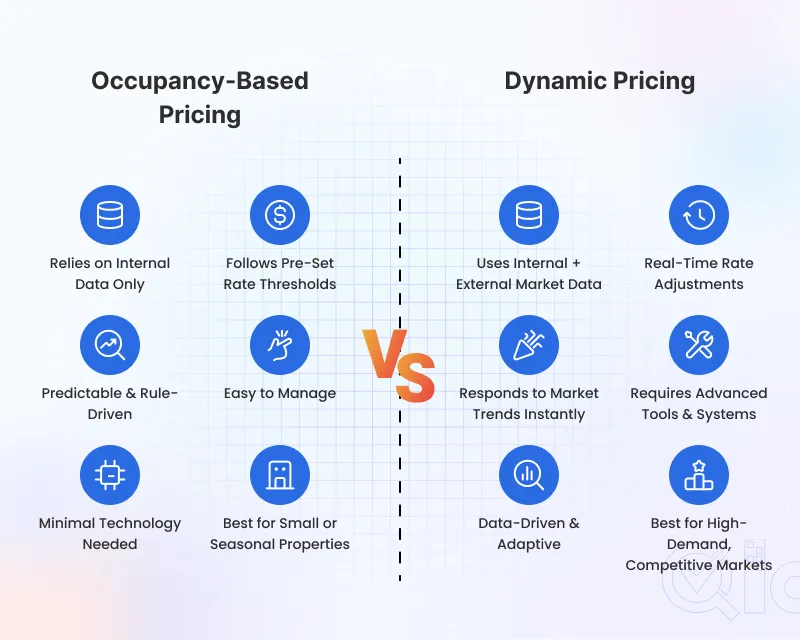
Dynamic pricing is data-driven and responsive. It moves with the market even when you are not watching.
Occupancy-based pricing requires less technology and less ongoing management.
Dynamic pricing requires reliable data feeds, a capable tool, and regular human review to make sure automated decisions stay sensible.
When Occupancy-Based Pricing Is the Right Fit
For smaller properties with consistent seasonal demand and lean management teams, an occupancy-based pricing strategy may be the best way to begin.
Some markets just run on a schedule. Busy summers, slow winters, and events you can mark on a calendar months ahead. That kind of predictability is where occupancy-based pricing does its best work.
Before each season, you lock in your pricing strategy. But you still revisit it throughout the year. Markets shift, and your rates should too
Simple thresholds. Solid base rates. For a lot of independent hotels, that combination quietly outperforms far more expensive systems.
When Dynamic Pricing Makes More Sense
Not every market is calm. City hotels and beach resorts during peak season can see demand swing wildly in just a few hours. That is exactly where dynamic pricing earns its place.
If a major concert sells out nearby, your competitors will raise rates within minutes. If a conference cancels at the last minute, they’ll drop rates to recover occupancy fast.
Dynamic pricing also helps properties that list across multiple online channels keep rates consistent and competitive everywhere simultaneously.
Which One Should You Choose?
Predictable demand and a small team? Occupancy-based pricing keeps you in control without piling extra work onto your staff
However, if you have been able to automate the processes necessary for dynamic pricing, you could utilise this to directly increase the revenue generated by each room available for rent.
Understanding how a modern PMS simplifies operations is worth your time before choosing either approach. Your pricing strategy depends on what your system can actually execute.
Conclusion
Occupancy-based pricing and dynamic pricing are not competitors. They serve different properties at different stages of growth.
One rewards simplicity and control. The other rewards market awareness and speed.
Few hotels get dynamic pricing right from day one. Most start simple, learn their demand patterns, and add dynamic adjustments gradually as they get more comfortable with the data.
Pick the approach that matches your property’s reality today. Refine it as your data improves. That is the honest path to better revenue.
Get In Touch
If you’re ready to elevate your hotel’s operations or have any questions, QloApps is here to assist!
Let’s collaborate to streamline your processes and enhance guest satisfaction.
Discover how QloApps’ Property Management System and Channel Manager solutions can simplify your operations and boost your revenue. Get in touch now!

Be the first to comment.