
Running one hotel keeps you busy enough.
Bookings, room availability, guest details, staff schedules, every one of them needs attention, every single day, in every property you own.
So it’s no surprise that hotel owners start searching for a Property Management System (PMS) that can pull all of this into one place.
But here’s the real question: can one PMS actually pull this off? Let’s see.
What Is Multi-Property Hotel Management?
Put simply, it’s when one business runs two or more hotels. Sometimes they’re in the same city. Sometimes they’re spread across different states or even countries.
Either way, someone still has to keep track of bookings, room inventory, guest info, staff, and reports for each location.
Try doing all that by hand for five hotels, and you’ll see how fast the hours disappear.
If you want to understand how a PMS plays a role in this, this guide on multi-property management in hotel chain expansion breaks it down well.
What Is a Hotel PMS?
A hotel PMS is just software built to run a hotel’s daily operations. Bookings, check-ins, check-outs, room assignments, guest records, and payments – it handles all of it.
Staff isn’t stuck doing this manually anymore; they log in, work through it, and make fewer mistakes along the way.
Owners get something out of it, too. They can finally track how their hotels are actually performing instead of guessing.
Key Features of a Multi-Property PMS
A PMS made for multiple hotels isn’t just basic software copied five times over. It’s packed with tools built for exactly this kind of juggling act.
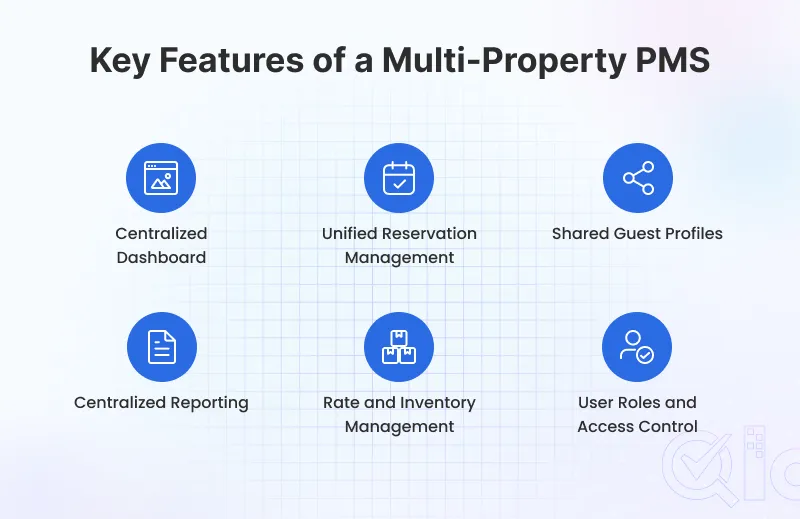
- Centralized Dashboard: One screen, every property. Managers get updates fast, without bouncing between five separate logins.
- Unified Reservation Management: Every booking, from every hotel, lands in one system. No mix-ups, no duplicate work.
- Shared Guest Profiles: Guest history lives in a single database. So when someone checks into a different property in your group, your staff already know a bit about them — and that goes a long way.
- Centralized Reporting: Managers can create reports for a single hotel or for all properties together. This makes it easier to track performance and make better decisions.
- Rate and Inventory Management: Rates and room availability update across every property in one move. Accurate, fast, and no hotel-by-hotel guesswork.
- User Roles and Access Control: Staff only see what their role needs. Keeps things secure, and honestly, keeps the system less cluttered too.
Benefits of Using One PMS for Multiple Hotels
With one system, owners get a full view of everything, no more switching between five different platforms just to get a clear picture.
Staff get more done in less time. Errors drop simply because the same data isn’t being typed in five separate places.
Reports, bookings, and guest info are all sitting right there when you need them.
Over time, this means lower costs and a guest experience that actually feels consistent, no matter which property someone walks into.
This breakdown of multi-property solution benefits covers the operational and financial side of this in more detail.
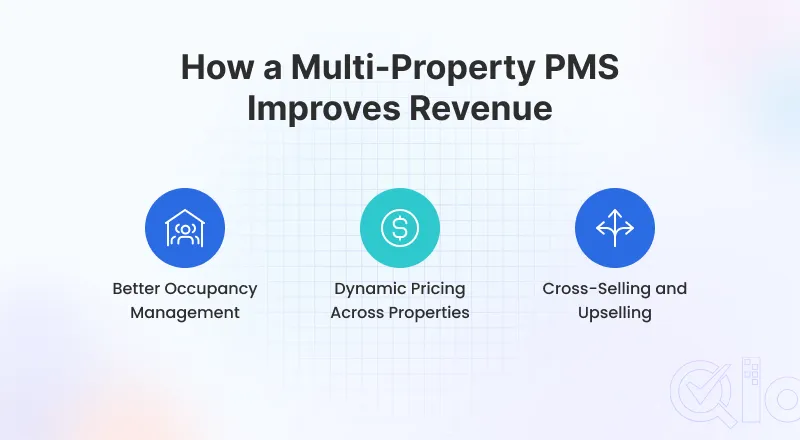
How a Multi-Property PMS Improves Revenue
- Better Occupancy Management: See room availability across every hotel, all at once. That alone helps fill rooms that would’ve otherwise sat empty.
- Dynamic Pricing Across Properties: Rates shift with demand and the market — and they shift everywhere together, not one hotel at a time.
- Cross-Selling and Upselling: Offer a guest a room upgrade, an extra service, or even a stay at a sister property. Small moves like these add up fast.
Who Needs a Multi-Property PMS?
Honestly, any business running more than one hotel. Hotel chains, resort groups, boutique brands, serviced apartments, vacation rental companies – all of them fit here.
The more properties you add, the harder it gets to manage each one separately.
A multi-property PMS brings it all under one roof, smooths out coordination between locations, and gives owners a much tighter grip on the business overall.
Future of Multi-Property Hotel Management
The future of multi-property hotel management is moving toward more automation. Hotels want systems that can handle daily tasks and reduce manual work as their business grows.
Modern PMS tools already manage bookings, pricing, guest data, and reports from one place, and that’s not slowing down.
This blog on AI and machine learning in hotel PMS shows where this is already heading: automated pricing, predictive maintenance, and guest personalization that runs without manual input.
Better tech means faster decisions, sharper guest experiences, and properties that keep running smoothly even as the group keeps growing.
Conclusion
Running multiple hotels without the right tools is genuinely tough.
A multi-property PMS pulls bookings, guest data, reports, and pricing into one system, which makes daily work so much easier.
It saves time, cuts down on errors, and keeps things consistent everywhere.
For hotel groups chasing steady growth and real control, one solid PMS isn’t just nice to have it’s the practical way to actually pull this off.
Get In Touch
If you want to learn about the functionality of QloApps, then you can visit this link: All-In-One Property Management System
In case of any query, issue, or requirement, please feel free to raise it on the QloApps Forum

Be the first to comment.