Hotel Trends 2026: 7 Mid-Year Shifts Every Hotel Must Act On
The first half of 2026 has changed the hospitality industry. Guest expectations are rising and booking habits are changing. Technology now plays a bigger role in daily hotel operations.
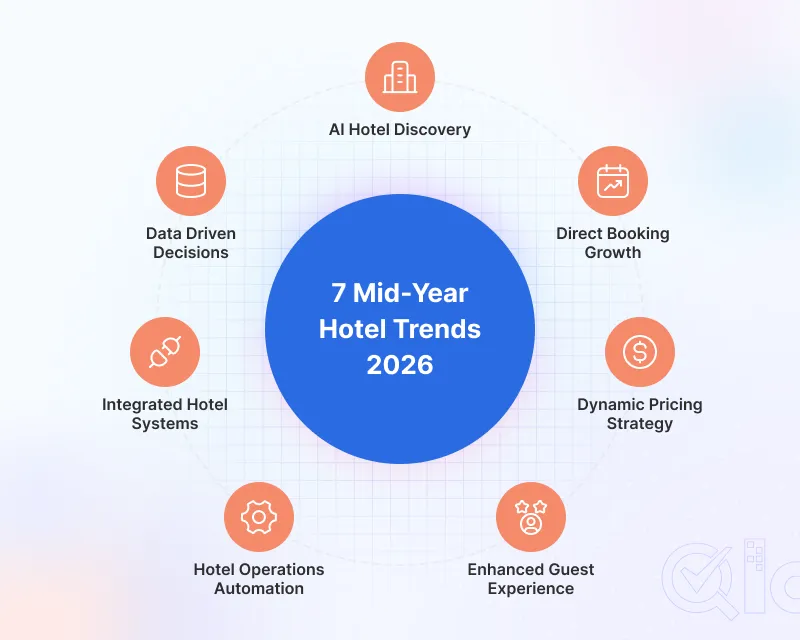
These hotel trends 2026 are changing how hotels attract guests, manage bookings, and grow revenue.
For hotel owners and managers, mid-year is the right time to review their strategy. The methods that worked at the start of the year may not deliver the same results in the months ahead.
The good news is that these changes also create new opportunities. Hotels that adapt early can improve guest satisfaction, increase direct bookings, and make daily work easier.
Let’s explore the biggest hotel trends 2026 and the steps your hotel can take to stay ahead.
Why Mid-Year Is the Right Time to Review Your Hotel Strategy
Mid-year is more than a checkpoint as it is the best time to review your hotel’s performance before the busiest travel season begins.
Review your occupancy, average daily rate (ADR), revenue per available room (RevPAR), booking sources, and guest reviews. These numbers show what is working and where you need to improve.
A mid-year review helps you make smart decisions before demand changes.
1. AI Is Changing How Guests Discover Hotels
One of the biggest hotel trends 2026 is the growing use of AI in travel planning.
Many travelers now ask AI to find hotels. They enter their budget, travel dates, location, and preferred amenities. AI quickly suggests hotels that match their needs.
This makes your hotel’s information more important than ever. If your room details, prices, amenities, or photos are outdated, AI may not recommend your hotel.
What hotels should do
- Keep room descriptions clear and accurate.
- Upload high-quality photos.
- Update amenities regularly.
- Encourage guests to leave genuine reviews.
- Keep prices and availability consistent across every booking channel.
2. Direct Bookings Continue to Grow
Another important hotel trend 2026 is the growing focus on direct bookings. OTAs help hotels reach more travelers. However, commission fees reduce profits.
Direct bookings help hotels earn more from every reservation. They also help build stronger guest relationships.
Hotels can also offer exclusive deals, loyalty rewards, and special packages through their own websites.
How to encourage direct bookings
- Create a fast and mobile-friendly booking experience.
- Offer flexible cancellation policies.
- Include benefits such as free breakfast or late checkout.
- Make your website simple and easy to navigate.
Guests often choose extra value instead of a lower room rate.
3. Dynamic Pricing Is Becoming Standard
Fixed room rates no longer match today’s market. Hotel demand can change quickly throughout the year due to several market factors.
Local events, holidays, weather, airline prices, and competitors all affects bookings. Hotels that adjust room rates based on demand can increase both occupancy and revenue.
Dynamic pricing does not always mean higher prices. It means charging the right price at the right time.
Why it matters
Hotels that keep fixed prices may lose revenue during busy periods. They may also struggle to attract guests during slower seasons.
Reviewing room rates regularly helps hotels stay competitive throughout the year.

4. Guest Experience Drives Growth
Among all hotel trends 2026, one stands out. Guests now value the overall experience as much as the room itself.
They expect an easy booking process. They also want quick replies, personal service, and smooth check-in.
Small details make a big difference. A welcome message, local recommendations, or remembering a returning guest’s preferences can encourage repeat bookings.
Improve every stage of the guest journey
Focus on every step of the guest journey:
- Before arrival
- During the stay
- After checkout
Every interaction shapes your reputation and influences future bookings.
5. Hotels Are Automating Daily Operations
Running a hotel involves many daily tasks. Reservations, room assignments, housekeeping, guest messages, payments, and inventory all take time.
Hotel automation helps staff finish these tasks faster. It also reduces mistakes. Automation does not replace staff instead, it gives them more time to help guests.
Benefits of hotel automation
- Saves time
- Reduces manual errors
- Improves team productivity
- Speeds up guest service
- Makes daily operations easier
Automation has become one of the most practical hotel trends 2026 because it helps hotels work more efficiently without increasing staff workload.
6. Connected Hotel Technology Is Replacing Separate Systems
Many hotels still use separate software for reservations, housekeeping, accounting, and channel management. This often creates duplicate work and inconsistent information.
That is why hotels now prefer integrated systems that connect every department.
When your PMS, Booking Engine, and Channel Manager work together, prices, room availability, and reservations update automatically.
This reduces errors and saves valuable time.
Why integration matters
Connected systems help hotels:
- Avoid overbookings.
- Keep room availability accurate.
- Update prices faster across booking channels.
- Improve staff productivity.
- Deliver a smoother guest experience.
7. Data Helps Hotels Make Better Decisions
Hotels collect valuable information every day. Booking trends, occupancy reports, guest preferences, cancellation data, and revenue reports provide useful insights.
Collecting data is no longer the biggest challenge for hotels. The real challenge is using it effectively.
Hotels that review reports regularly can improve pricing, marketing, staffing, and guest service. Better decisions lead to better business growth.
What These Hotel Trends 2026 Mean for Independent Hotels
Large hotel chains often have dedicated revenue managers and technology teams. While the independent hotels usually work with smaller teams and tighter budgets.
That makes choosing the right technology even more important.
Many independent hotels now choose one integrated system instead of several disconnected tools. This saves time, reduces manual work, and supports future growth.
The goal is not to adopt every new technology. The goal is to invest in solutions that solve real business problems.
How QloApps Helps Hotels Keep Up with Hotel Trends 2026
Keeping up with hotel trends 2026 is easier when all hotel operations run on one platform.
QloApps combines a Property Management System (PMS), Booking Engine, and Channel Manager into one solution.
Hotels can manage reservations, room inventory, pricing, and guest information from a single dashboard.
With QloApps, hotels can:
- Accept direct online bookings.
- Manage reservations with ease.
- Keep room availability updated across booking channels.
- Simplify front desk operations.
- Coordinate housekeeping.
- Improve the guest booking experience.
Hotel teams no longer need to switch between different systems. They can manage daily work from one dashboard and spend more time helping guests.
Conclusion
The biggest hotel trends 2026 all point in the same direction. Hotels need to become more efficient while delivering better guest experiences.
AI, direct bookings, dynamic pricing, automation, connected systems, and better use of data are no longer ideas for the future. They are already shaping daily hotel operations.
Now is the right time to review your strategy and prepare for the rest of the year.
Hotels that adapt early can increase revenue, improve guest satisfaction, and stay ahead of the competition.
Get in Touch
Looking to modernize your hotel operations? With QloApps, you can handle your daily hotel operations smoothly from a single, easy-to-use platform.
Have questions or ideas? Join the QloApps forum and share your thoughts. Need setup help? Raise a support ticket, and our team will help you.