
The New Rules of Hotel Discovery in the AI Era
A few years ago, most travelers started with Google search. They opened several booking websites, compared prices, checked photos, read reviews, and picked a hotel.
Today, that journey is changing as many travelers no longer search through endless hotel listings. Instead, they simply ask AI booking agents to do the work for them.
They simply type prompts like: “Find me a beachfront hotel in Goa with free breakfast and great reviews.”
Within seconds, the booking agent suggests a shortlist of hotels that closely matches the traveler’s request.
If your hotel isn’t on that list, you could miss potential bookings even if your property is exactly what the traveler needs.
So, how do AI booking agents decide which hotels to recommend?
Every recommendation follows a simple process in which AI collects hotel data, compares the options, and suggests the best match.
For hotels, simply having an online presence is no longer enough.
Your hotel also needs accurate, complete, and trustworthy information that AI can easily understand.
Let’s explore how the process works.
The Shift from Search to AI Recommendations
Traditional search engines showed travelers a long list of results. They had to compare hotels, read reviews, and choose the one that best matched their needs.
AI booking agents work differently, as they first understand what the traveler is looking for. The booking agent gathers hotel information by comparing the available options.
It recommends the hotels that best match the traveler’s request, which makes travel planning faster, more personal, and easier.
As AI becomes a bigger part of trip planning, understanding how these recommendations work can help your hotel stay visible to future guests.
How AI Booking Agents Discover Hotels
Although recommendations appear within seconds, several steps happen behind the scenes before a hotel is suggested.
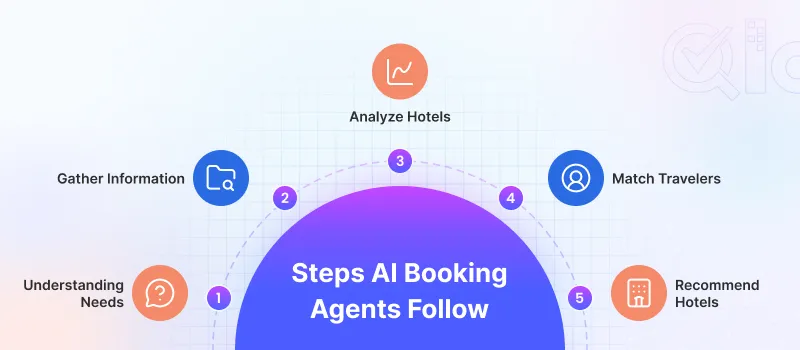
Step 1: Understanding the Traveler’s Needs
Everything starts with the traveler’s request for example: “Find me a family-friendly hotel near the beach with free breakfast and a swimming pool.”
Instead of focusing only on keywords, AI understands the intent behind the request.
It identifies important details such as the destination, travel dates, budget, preferred amenities, and the purpose of the trip.
These details help narrow the search. The booking agent then looks for hotels that best match the traveler’s needs.
The better AI understands the traveler, the more relevant its recommendations become.
Step 2: Collecting Hotel Information
AI booking agents gather information from hotel websites, Google Business Profiles, OTAs, review sites, maps, and other trusted travel sources.
It doesn’t rely on just one source. Instead, it compares information from several trusted platforms. This helps build a more complete picture of each hotel.
What this means for your hotel: Keep your website, OTA listings, and Google Business Profile updated with consistent information.
Accurate information makes it easier for AI to understand and trust your hotel.
Step 3: Understanding Each Hotel
Once enough information is available, the booking agent reviews each hotel. It checks room types, prices, amenities, guest reviews, photos, cancellation rules, and descriptions.
This helps the booking agent understand what the hotel offers and who it is best suited for.
For example, a business traveler may be shown hotels with meeting rooms and high-speed Wi-Fi.
A family, on the other hand, may see properties with larger rooms, kid-friendly facilities, and nearby attractions.
The clearer your hotel information is, the easier it becomes for AI to match your property with the right guests.
Step 4: Matching Hotels with Traveler Preferences
This is where the recommendations become more personal. AI compares the traveler’s preferences with the available hotels to find the best match.
Two travelers searching for hotels in the same city may receive completely different recommendations because their needs are different.
Rather than recommending the most popular hotels, AI focuses on the ones that best match the traveler’s needs.
Step 5: Recommending the Best Hotels
After completing its analysis, the booking agent presents a shortlist of hotels along with explanations for why each property was selected.
For example, it may match the traveler’s budget, offer free breakfast, have excellent reviews, or be close to popular attractions.
This makes it easier for travelers to compare their options and book with confidence.
Why Some Hotels Get Recommended More Often
Not every hotel has the same chance of appearing in AI recommendations.
Hotels with clear and reliable information are easier to understand. As a result, they are more likely to be recommended.
Keeping room descriptions, amenities, pricing, and policies updated creates a stronger online presence.
When the same information appears consistently across different platforms, AI can trust it more.
Guest reviews also play a major role as positive reviews help AI understand that guests consistently enjoy staying at your property.
Simply put, hotels that are easier to understand online are also easier to recommend to the right travelers.
How Hotels Can Improve Their AI Visibility
You don’t need a separate marketing strategy just for AI. Instead, focus on building a strong digital foundation.
Here are a few easy ways to improve your hotel’s visibility:
- Keep room descriptions detailed and up to date.
- Maintain consistent information across your website and OTA listings.
- Regularly update prices, availability, and amenities.
- Encourage genuine guest reviews and respond to feedback.
- Use high-quality photos that accurately represent your property.
- Keep your Google Business Profile complete and updated.
These simple improvements make it easier for AI booking agents to understand your hotel and recommend it to travelers looking for a property like yours.
How QloApps Helps Hotels Stay AI-Ready
Keeping hotel information updated across multiple booking channels takes time.
Manual updates often result in inconsistencies that affect both guest bookings and AI recommendations.
QloApps helps hotels manage reservations, room inventory, pricing, and direct bookings from one centralized platform.
QloApps keeps hotel information organized across different booking channels. This helps maintain accurate and consistent information that AI booking agents can rely on.
As AI continues to reshape hotel discovery, accurate and up-to-date hotel information will remain one of the most important factors in improving digital visibility.
Conclusion
AI booking agents are changing how travelers discover and book hotels.
Travelers no longer need to scroll through hundreds of hotel listings. They can simply ask an AI booking agent for recommendations that match their needs.
For hotels, success in the AI era depends on more than marketing.
Accurate information, consistent listings, positive guest reviews, and a seamless booking experience all help AI understand and recommend your property.
Keeping your hotel information accurate and up to date makes it easier for travelers to find and trust your property.
With QloApps, you can manage your hotel data from one place and stay prepared as AI continues to shape the future of hotel bookings.
Get in Touch
Want to make your hotel AI-ready? Get in touch with our team to see how QloApps can help you manage your hotel more efficiently and increase direct bookings.
Have questions or ideas? Join the QloApps forum and share your thoughts. Need setup help? Raise a support ticket, and our team will help you.

Be the first to comment.