
Big changes are hitting hotel rate parity rules this year. Since 2024, regulators and courts have moved away from outdated online travel agency (OTA) terms.
Hotels need to know what changed and why it matters. New rules affect how hotels can price their own rooms.
This guide explains the new rules in simple terms. It also shows how hotels can adapt and win more direct bookings.
What Is Hotel Rate Parity
Hotel rate parity means a hotel must charge the same room price everywhere online. This rule covers both the hotel website and OTA sites like Booking.com and Expedia.
Hotels agree to this rule when they sign an OTA contract. It stops hotels from offering a lower price on their own website.
Wide Parity vs. Narrow Parity
There are two main types of hotel rate parity rules. Each one controls hotel prices differently.
Wide Price Parity
This rule stops a hotel from offering cheaper rates to any other website or guest. All public pricing remains completely locked across the web.
Narrow Price Parity
A narrow rate parity clause permits discounts on competing third-party apps. However, the hotel still cannot undercut that price on its own site.
The New OTA Rules in 2026
Governments and courts around the world are now changing these old rules. Hotels are slowly getting more control over their prices.
The CJEU Ruling, Explained
A top European court reviewed hotel rate parity rules in September 2024. It ruled that strict pricing rules were not always fair.
This ruling did not ban parity rules everywhere right away. But it made these rules much harder for OTAs to defend in court.
Booking.com and the Digital Markets Act
The European Union named Booking.com a major gatekeeper in May 2024. This came from a new law called the Digital Markets Act.
Because of this law, Booking.com dropped its strict pricing rules in Europe by late 2024. Hotels there can now set lower prices on their own sites.
Countries That Banned Parity Clauses Outright
Some countries acted even earlier than the EU court. France, Italy, Austria, and Belgium banned strict parity rules by law years ago.
Germany banned these rules a different way. Its competition authority ruled against Booking.com, and top courts later agreed.
These laws protect all hotels from unfair pricing rules. Hotels in these countries can set their own prices freely.
Where Wide Parity Still Applies (United States)
The United States has no national ban on parity rules yet. Many OTA contracts still use strict pricing terms.
US courts have mostly upheld these rules so far. Hotel owners there should watch new rulings closely.
India’s CCI Ruling Against MakeMyTrip and OYO
India’s competition regulator, the CCI, fined MakeMyTrip and OYO in October 2022. The fines were for unfair pricing rules and exclusive deals.
The companies appealed, and the case is still open in 2026. India has no law directly banning parity rules, unlike France.
In 2024, the CCI opened a new case to investigate possible unfair teamwork among OTAs. Reports in 2026 suggest some pricing pressure may continue.
Because of this, most Indian OTA contracts still include parity rules today. Hotel owners in India should read their contracts carefully.
Why New Rules Don’t Automatically Mean More Direct Bookings
New rules give hotels more freedom on paper. But OTAs still fight hard to keep guests on their own apps.
OTAs often lower their own profit to beat a hotel’s price. They also offer member discounts and price match deals.
Hotels must earn guest trust to win direct bookings. Clear value and honest pricing work better than rules alone.
Common Rate Parity Issues Hotels Still Face
Wholesaler Leakage: Third-party distributors quietly resell your discounted bulk rooms to public sites, breaking your target retail pricing strategy.
Rate Shaving: Online travel agencies slash their own commission cut to lower your room price without your explicit knowledge or permission.
Sync Errors: An outdated system may fail to update prices across all channels simultaneously. Use an updated, modern channel manager to prevent this.
Mobile Rate Discounts: Some OTAs show a lower price only in their app or to members. This does not break your contract, but it still undercuts you.
How Hotels Can Adapt to the New OTA Rules
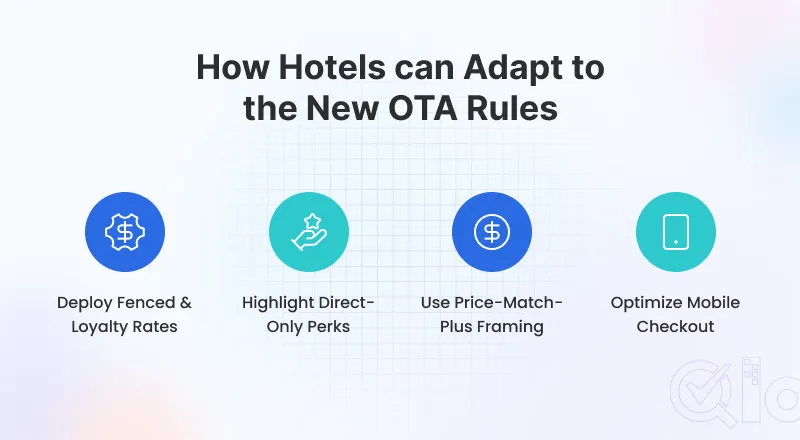
Deploy Fenced and Loyalty Rates
Hotels can share private, fenced rates with closed user groups like email clubs. These hidden prices do not violate active contract rules.
Highlight Direct-Only Perks
Offer exclusive website benefits like free breakfast, early check-in, or room upgrades. These special add-ons make direct deals far more attractive.
Use Price-Match-Plus Framing
Display a prominent price guarantee on your booking engine to remove booking fear. Promise to match any lower rate and add a bonus reward.
Optimize for Mobile Bookings
Ensure your official direct booking engine is incredibly fast and optimized for smartphones. A simple two-click checkout stops guests from leaving.
The Role of a PMS in Managing Rate Parity
A property management system helps hotels manage hotel rate parity with ease. It keeps room rates the same across every site.
It also connects to a channel manager for real-time updates. This stops manual mistakes and saves staff a lot of time.
Open software like QloApps helps small hotels manage this without high costs. It gives independent hotels more control over direct bookings.
Conclusion
Hotel rate parity rules are being relaxed in many parts of the world. Hotels now have more freedom to set their own prices.
But rules alone will not win more direct bookings. Guest trust and a smooth booking experience matter just as much.
A good PMS like QloApps can help you manage prices with ease. Take control of your hotel rate parity strategy today.
Get In Touch
Ready to optimize your hotel’s direct bookings and manage rate parity effortlessly? QloApps is here to assist!
Let’s collaborate to streamline your processes and enhance guest satisfaction.
Discover how QloApps’ Property Management System and Channel Manager solutions can simplify your operations and boost your revenue. Get in touch now!

Be the first to comment.