How to Write Hotel FAQs That Rank on Google
Hotel FAQs are one of the most overlooked pages on a property’s website. Written well, hotel FAQs can rank on Google, answer real guest questions, and quietly drive direct bookings.
Most hotels treat this page as an afterthought, filled with generic questions no one searches for. Hotel FAQs only earn traffic when they answer what travelers actually type into Google.
This guide covers how to research, write, and structure hotel FAQs that actually rank. It also shows how this content supports AI search tools, not just traditional results.
Why Hotel FAQs Matter More in 2026
Search behavior has shifted toward full questions rather than short keyword phrases. Travelers now type things like “does this hotel have a pool” instead of just “hotel pool.”
Google increasingly surfaces direct answers through snippets and AI Overviews. Hotel FAQs built for AI search have a real shot here.
Voice search adds another layer to this shift. People speaking to an assistant ask full, natural questions, and hotel FAQs written the same way match that pattern closely.

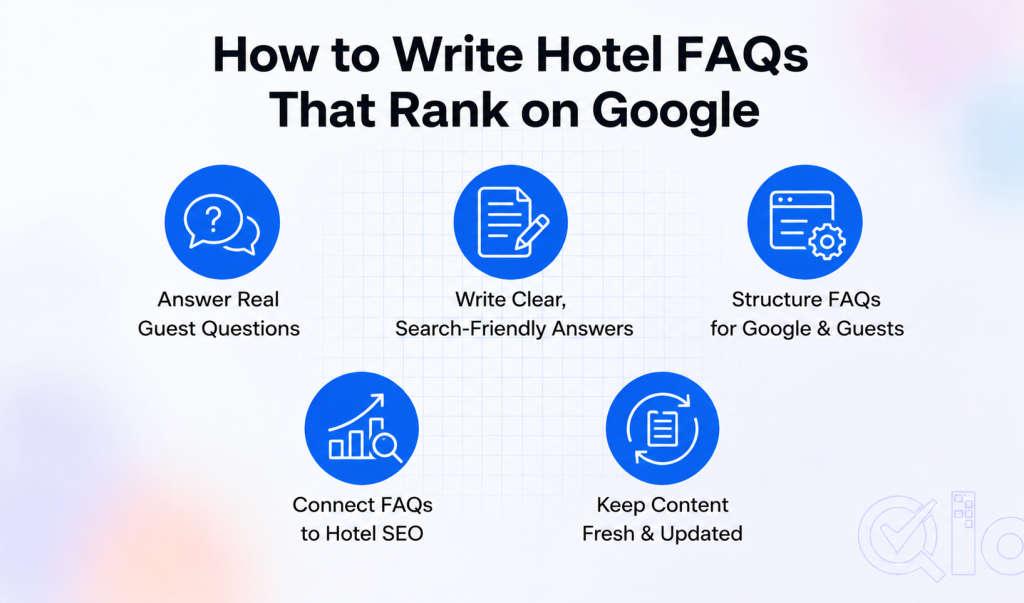
Start With Real Guest Questions, Not Guesses
The biggest mistake hotels make is writing FAQs from the owner’s perspective, not the guest’s. A question like “What amenities do we offer?” rarely matches how anyone actually searches.
Look at real guest emails, front desk calls, and OTA messages for recurring questions. These are the exact phrases and concerns worth turning into FAQ entries.
Keyword research also helps confirm what people search for locally.
Google’s “People Also Ask” boxes are another reliable source of real questions. Searching your hotel’s category and location often surfaces exact phrasing worth answering directly.
Write Answers That Actually Rank
Each FAQ answer should start with a direct response in the first sentence. Google favors content that answers the question immediately, not after several lines of setup.
Keep answers between forty and eighty words for most questions. Short enough to be scannable, but detailed enough to fully answer what was asked.
Use the guest’s own phrasing in both the question and the answer. If people search “is parking free,” the answer should include that exact phrase naturally.
Avoid vague answers like “please contact us for details.” A hotel FAQ that dodges the actual answer rarely earns a ranking or a click.
Structure FAQs for Both Google and Guests
Group questions by topic instead of listing them randomly on one long page. Check-in, parking, pet policy, and amenities each deserve their own clear section.
Use FAQ schema markup so Google can display answers directly in search results. This structured data is what allows hotel FAQs to appear as rich snippets rather than plain blue links.
Tools like QloApps SEO Optimization help manage this data alongside SEO settings. This markup often decides whether a page ranks.
Keep the page mobile-friendly with short paragraphs and clear headers. Most guests searching hotel questions are doing so from a phone, often while comparing several properties at once.
Tie FAQs Into Your Broader SEO Strategy
Hotel FAQs work best as part of a wider content and local SEO effort. A full local SEO strategy helps this content connect to nearby search intent.
Linking FAQ answers to relevant pages, like booking or amenity pages, keeps guests moving toward a reservation. A well-placed link can turn an informational visit into a direct booking.
Reviewing your site’s hotel SEO foundation ensures FAQs aren’t the only piece working. Technical SEO supports every page.
Keep FAQs Updated as Policies Change
Outdated answers hurt guest trust and can hurt rankings over time too. A FAQ page listing an old cancellation policy creates confusion and disappointed guests at checkout.
Review this page quarterly with policy changes at the property. A connected property management system keeps pricing and policy details accurate.
Common FAQ Mistakes That Hurt Rankings
Burying real answers inside long, unrelated paragraphs confuses both readers and search engines. Google’s algorithms favor clear, direct answers over dense blocks of marketing copy.
Duplicating the same question across multiple pages splits ranking signals instead of strengthening them. Keep each question in one place so search engines know exactly where to send traffic.
Writing overly broad questions that never get answered specifically also hurts performance. A vague entry like “What should I know before booking?” rarely satisfies a searcher’s actual intent.
Final Thoughts
Hotel FAQs are a simple page with outsized potential when written around real guest questions. They rank because they answer exactly what people are already searching for.
Treat this page as a living document tied to real questions, not a static list. Hotels that keep their FAQs current will keep earning the traffic this page was meant to bring in.
Get In Touch
Ready to make your hotel website more useful for guests and search engines?
Get in touch with the QloApps team to explore solutions that can help you improve your hotel website, SEO, and direct booking experience.
If you have any suggestions, you can share them on the QloApps forum. For any technical assistance, kindly raise a ticket.