
Your hotel gets bookings from many channels each week. One comes from an online travel agency (OTA), one from your hotel website, and one from a travel agent using GDS for independent hotels.
GDS stands for Global Distribution System. It connects your hotel with travel agents and corporate booking channels, enabling them to find and book your rooms on behalf of business travelers.
This guide breaks down GDS for independent hotels into costs, benefits, and a simple decision matrix to help you make a decision.
More travel agents and corporate travel platforms are shifting toward digital booking tools in 2026. This makes the GDS decision more relevant for independent hotels than it was a few years ago.
The Real Cost of GDS for Independent Hotels
Direct costs you will pay
GDS platforms charge commission on each booking made. This commission usually falls between 10 and 15 percent per reservation.
A $5,000 booking means you pay $500 to $750 in commission fees. This is the main direct cost hotels face when using GDS.
Hidden costs many hotels forget
Rate parity rules mean your GDS price cannot be lower than other channels. Manually monitoring this across platforms can cost several hours of staff time weekly.
Booking mistakes can lead to overbooking, which costs $1,500 to $3,000 per incident. Travel agents also send enquiries that never turn into bookings, wasting staff response time.
A real example for your hotel
Picture a 40-room hotel getting 25 GDS bookings monthly, each averaging $300. That totals $7,500 in monthly booking revenue for the hotel.
At 12 percent commission, the hotel pays $900 to GDS each month. This leaves $6,600 in net revenue from those bookings alone.
Which Independent Hotels Should Use GDS
Hotels that benefit from GDS
Hotels near business districts and corporate offices see the strongest results with GDS for independent hotels. If 40 percent of your guests are business travelers, this channel works for you.
Premium hotels with room rates above $150 per night also profit well. Higher rates mean your profit stays strong even after paying commission.
Hotels in gateway cities and near airports attract more agent bookings. Travel agents book these locations more often for corporate and transit guests.
Hotels that should skip GDS
Budget hotels with rates below $60 per night often struggle with GDS costs. The commission takes too large a bite out of your smaller room rates.
Resort and beach hotels usually do better with OTAs and direct bookings. Leisure travelers rarely book through travel agents on GDS platforms.
Hotels without a property management system are not ready for GDS. Manual systems and spreadsheets lack real-time tracking and cause costly errors.
The Technology Behind GDS
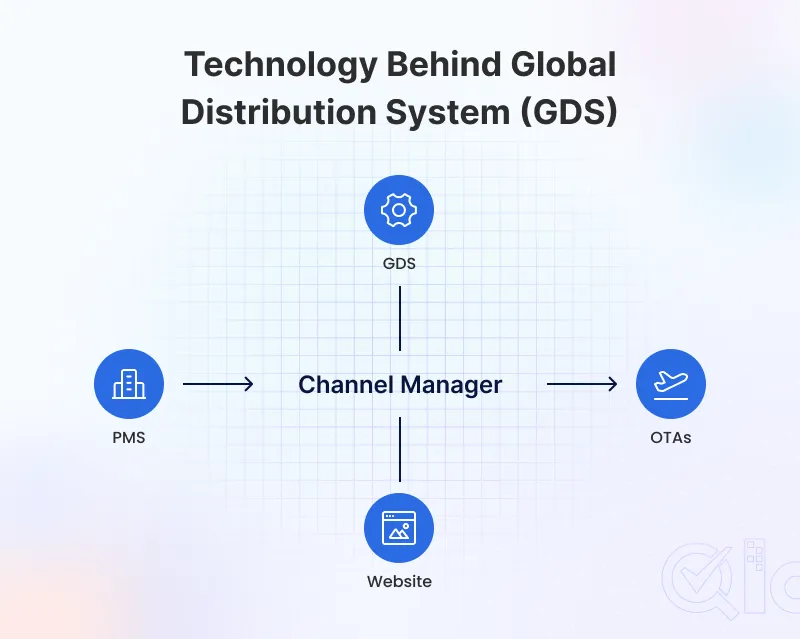
A property management system connects your hotel operations to online booking channels. It keeps your room data organized in one central place.
A channel manager works alongside your PMS, syncing rates and rooms across GDS, OTAs, and your website. This keeps every channel updated automatically.
Without this setup, updating prices means manual work on every platform. This raises overbooking risk and makes GDS harder to manage well.
Decision Matrix: Should Your Hotel Use GDS?
Answer these eight questions about your property. Give yourself one point for every question you answer with a yes.
- Is your average room rate $150 per night or higher?
- Does your hotel have 30 rooms or more?
- Is your occupancy rate 60 percent or above?
- Do you use modern hotel management software?
- Can your team manage real-time inventory?
- Does your staff understand distribution channels well?
- Do business travelers make up 30 percent of your guests?
- Is your hotel located in a business hub or gateway city?
What your score means for you
- 6 to 8 points: GDS is likely a smart move. Start with one provider and try a six-month test period.
- 4 to 5 points: GDS could work with careful testing. Try one provider for 90 days before making a bigger commitment.
- 2 to 3 points: Wait on GDS for now. Focus on improving your current booking channels first.
- 0 to 1 point: GDS is not right for you now. Put your energy into growing direct bookings instead.
Common Mistakes Hotels Make With GDS
Breaking rate parity
Some hotels offer lower prices on their website than on GDS. This breaks agent trust and can get your listing blocked from the platform.
Listing rooms you do not have
Never list the same rooms across GDS, OTAs, and your website without a channel manager syncing inventory. This causes overbooking and damages guest trust fast.
Ignoring agent enquiries
Travel agents expect replies within a few hours. Slow responses send bookings straight to your competitors instead.
Signing long contracts too early
Some hotels lock into multi-year GDS deals before testing results. Start with a short pilot contract instead, so you can exit if it does not work.
Conclusion
GDS is one option among many for your hotel, not something every property must have. Your final choice should depend on your hotel type, location, and current channels.
Most hotels that succeed with GDS do not rely on it alone. They mix GDS with OTAs and direct bookings, letting each channel bring in the type of guest it serves best.
Corporate travel is recovering steadily into 2026, with more bookings through agents. This is a good time to revisit your distribution strategy.
If your current channels already work well, you have full permission to skip GDS completely. Review your distribution strategy every year, since markets and guest habits keep changing.
Get In Touch
Ready to explore hotel technology that supports GDS, channel managers, and real-time inventory? The right property management system makes distribution simple.
Reach out to QloApps to learn how modern hotel software can connect your rooms to GDS, OTAs, and direct bookings, all synced automatically in one place.

Be the first to comment.