
During major events, hotels experience higher demand, which can make managing reservations and operations more difficult.
A cloud PMS changes how hotels deal with all of this. It keeps bookings in order, updates availability in real time, and holds hotel operations together when demand goes through the roof.
In 2026, hotels that want to stay ahead during major events are making the shift to cloud-based systems, and the results speak for themselves.
What Is a Cloud PMS?
A cloud PMS is hotel management software that runs through the internet. Staff can log in from a laptop, a phone, or a tablet wherever they happen to be.
If you are still weighing your options, this breakdown of cloud vs. on-premise property management systems covers the key differences and helps clarify which setup suits your property best.
Hotel owners do not need to be standing at the front desk to know what is happening at their property. That kind of flexibility is exactly what modern hotel operations need.
Challenges Hotels Face During Big Events
When a big event comes to town, hotels receive a large number of booking requests at the same time through OTAs, direct websites, and phone calls.
Rooms get booked twice because the availability did not update fast enough. Guests queue at the front desk longer than they should.
Pricing needs to shift with demand, but nobody has the time to update it across every platform manually.
How Cloud PMS Helps During Demand Surges
A cloud-based PMS gives smaller hotels the same operational firepower that larger chains rely on, and during a demand surge, that matters more than ever.
- Real-Time Room Availability — The moment a room gets booked, every connected channel reflects that change instantly. That small window where double bookings sneak through simply disappears.
- Faster Check-In and Check-Out — Guest details and booking records all live in one system. Staff pull up a reservation in seconds and get guests checked in without the usual back and forth
- Centralized Hotel Operations — One dashboard handles everything: reservations, housekeeping, payments, and guest notes. Every department works from the same information, updated in real time, so nothing falls through the gap between teams.
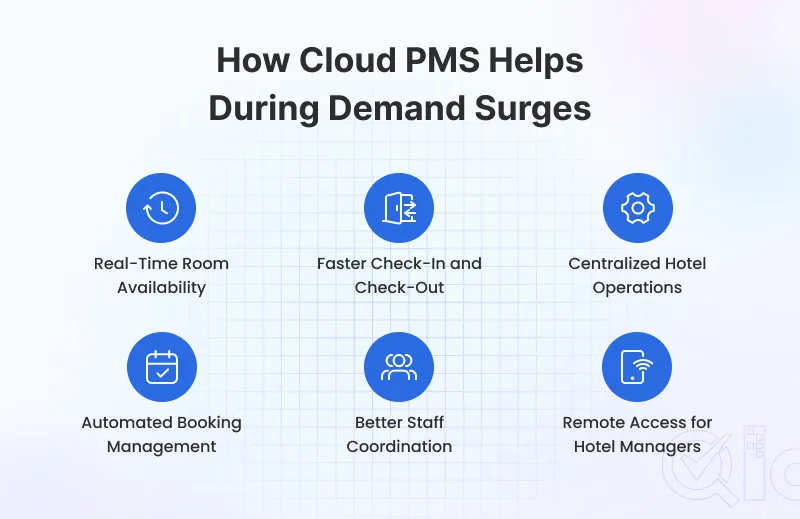
- Automated Booking Management — New bookings record themselves and room statuses update without anyone having to do it manually. Staff get that time back and can put it toward actually looking after guests instead of chasing paperwork.
- Better Staff Coordination — Front desk, housekeeping, management, everyone sees the same live data. When a room is ready, it shows immediately. That kind of alignment keeps operations moving smoothly even on the busiest days.
- Remote Access for Hotel Managers — Managers are rarely sitting at a desk during a major event. A cloud PMS lets them check occupancy, review bookings, and pull reports straight from their phone, wherever they are on the property or off it entirely.
Managing Room Rates During High-Demand Events
Pricing during peak demand is not something hotels can afford to get wrong. Rates that are too low leave revenue behind.
A cloud PMS allows hotel staff to update room prices from one place, and the changes are automatically applied to all booking channels.
This deep dive into how dynamic pricing boosts hotel profit is a solid starting point for building a rate strategy around real demand patterns rather than guesswork.
Preventing Overbookings with Channel Management
Selling rooms across multiple platforms at once is standard practice, but keeping inventory accurate across all of them manually is where things fall apart.
A channel manager in a cloud PMS updates room availability automatically, so every new booking is reflected on all channels right away.
The result is fewer errors, less firefighting for staff, and guests who actually get the room they paid for.
Cloud PMS Trends for 2026
Contactless check-in has gone from a pandemic workaround to a genuine guest preference that hotels are actively building around.
Smarter analytics tools are helping hotels read booking patterns early and prepare for surges before they arrive rather than scrambling once they hit.
The overall shift is toward systems that do more of the heavy lifting so staff can focus on the part of hospitality that actually requires a human touch.
Conclusion
Busy seasons and major events will continue to increase, making hotel operations more challenging every year.
A cloud PMS gives hotels the foundation to handle that pressure without operations breaking down at the worst possible moment.
Less manual work, fewer errors, better guest experiences, stronger revenue. That is what the right system delivers, and in 2026, it is quickly becoming the standard rather than the exception.
Get In Touch
If you’re ready to elevate your hotel’s operations or have any questions, QloApps is here to assist!
Let’s collaborate to streamline your processes and enhance guest satisfaction.
Discover how QloApps’ Property Management System and Channel Manager solutions can simplify your operations and boost your revenue. Get in touch now!

Be the first to comment.