Will AI Travel Agents Replace OTAs? Meaning for Hotels 2026
AI is changing how people plan and book trips. Instead of browsing multiple websites, travelers now ask AI travel agents to find hotels, compare options, and recommend the best stay.
This has created an important question for the hospitality industry. Will AI travel agents replace Online Travel Agencies (OTAs)?
At first, the answer seems obvious. Since AI can find hotels, compare prices, and even assist with bookings, it may seem that OTAs will become less important.
But hotel distribution is much more than hotel search. OTAs do more than display hotel listings.
They manage room availability, process payments, handle cancellations, and help travelers when problems arise. They also work with hotels around the world.
So, AI is unlikely to replace OTAs completely. Instead, it will change how travelers discover hotels and decide where to book.

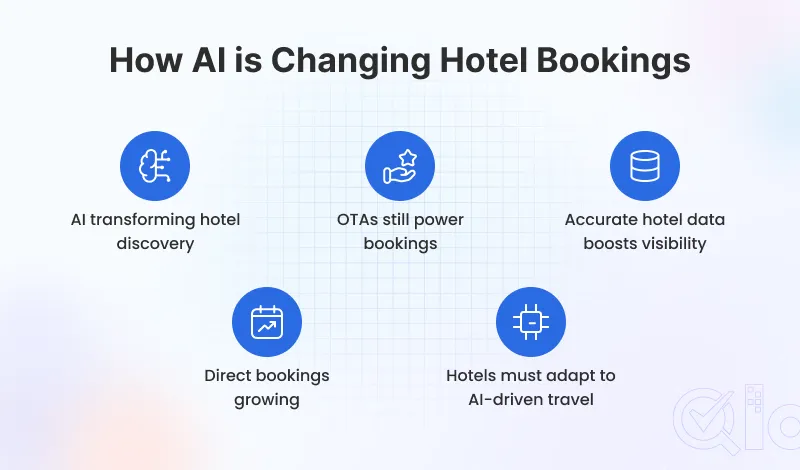
AI Is Turning Hotel Search into a Conversation
Booking a hotel usually takes time. Travelers need to choose a destination, enter travel dates, apply filters, compare hotels, read reviews, and check hotel policies before they book.
Instead of making travelers use multiple search filters, AI understands natural language and recommends hotels that match their complete travel needs, making booking faster and easier.
A traveler can ask:
“Find me a hotel in Barcelona for a two-night business trip. I need a quiet room, breakfast before 7 AM, easy airport access, flexible cancellation, and a budget below €200 per night.”
Rather than treating each requirement as a separate filter, AI understands what the traveler is looking for.
It looks at the travel purpose, budget, location, and preferences together. Then it recommends only the most suitable hotels.
If the traveler changes the budget or adds another requirement, the suggestions update instantly.
As a result, travelers spend less time searching and more time choosing between a few relevant options.
For hotels, this represents one of the biggest changes in online discovery. Travelers may spend less time browsing large hotel lists and rely more on AI recommendations.
Finding a Hotel Is Easier Than Booking One
Helping someone discover a hotel is only part of the journey. Completing a booking is much more complex.
A booking needs accurate room availability, live prices, clear rules, taxes, secure payment, and customer support.
Many things can change during the booking process. A room may sell out before payment is completed or the prices may change.
A guest may need to modify a reservation after a delayed flight. A cancellation request may require assistance.
These situations require more than intelligent recommendations. This is where OTAs still play an important role.
OTAs have spent years building reliable booking systems. They manage inventory, payments, booking changes, and customer support.
Because of this, AI travel agents are more likely to work alongside OTAs, hotel booking engines, and other booking platforms instead of replacing them.
A future booking journey could look like this:
Traveler → AI Travel Agent → Inventory Source → Booking Provider → Hotel
Even if the OTA continues to process the booking, the traveler may no longer interact with it directly because the AI assistant becomes the primary interface throughout the search process.
The Biggest Change May Happen Before the Booking
If OTAs continue managing reservations, where does AI create the biggest disruption? The answer may be at the beginning of the customer journey.
Today, most travelers begin their hotel search on an OTA, where they browse hundreds of properties, apply filters, compare prices, and eventually narrow down their options.
AI changes this process. Imagine asking:
“Which hotel is best for a late arrival in Singapore if I have an early meeting near Raffles Place and want to avoid a long morning commute?”
Instead of showing hundreds of results, AI may recommend only a few hotels that match the request.
If travelers begin trusting these recommendations, they may no longer browse long OTA search pages. That changes hotel visibility.
Hotels will no longer compete only for higher search rankings. They will also compete to become one of the few hotels AI travel agents recommend.
Hotel Visibility Becomes a Matching Problem
This shift could also change how hotels describe themselves online. Many hotel descriptions use broad marketing phrases such as: “Prime location”, “Unforgettable hospitality.”
These statements sound attractive, but they do not help AI understand who the hotel is best suited for.
Now compare that with this description:
“Located 300 meters from the metro, offers 24-hour check-in, breakfast from 6:30 AM, airport transfers, family rooms, and on-site parking.”
Unlike generic marketing phrases, the second description provides clear and specific information. It helps both AI systems and travelers understand who the hotel is best suited for.
Hotels no longer need to appeal to everyone. They need to clearly match the needs of specific travelers.
Features like early breakfast, late check-in, accessible rooms, EV charging, and airport transfers may help hotels appear in more AI recommendations.
Hotel Data Is Becoming More Important
AI travel agent can only recommend hotels based on the information it receives. If hotel information is incomplete or inconsistent, recommendations become less reliable.
For example:
- Breakfast hours may differ across booking channels.
- Room names may not match.
- Accessibility features may be missing.
For travelers, this creates confusion and for AI, it creates uncertainty.
That means hotel data is no longer just a part of daily hotel operations. It has become an important part of hotel distribution.
Hotels should keep their room descriptions, amenities, policies, pricing, and booking conditions accurate across every channel.
The goal is simple: make the hotel easy to understand wherever travelers discover it.
Could AI Increase Direct Bookings?
AI could also create more opportunities for direct bookings. Imagine an AI travel agent recommending a hotel because it perfectly matches a traveler’s needs.
If that hotel provides live availability, transparent pricing, payment options, and instant confirmation through its own booking engine, the traveler may book directly.
For independent hotels, this could be a major advantage.
Instead of relying only on advertising or OTA rankings, they can gain visibility because they are the best match for a traveler’s request.
However, AI cannot fix a poor booking experience.
If the website is slow, prices are confusing, or room availability is inaccurate, travelers may still choose an OTA.
AI can bring visitors but the hotel must still convert them into guests.
AI Could Become Another Gatekeeper
Hotels should also consider another possibility.
If only a few AI assistants become the main starting point for travel planning, those platforms could gain significant control over hotel discovery.
That raises several important questions like: “How will AI rank hotels?”, “Which inventory sources will it trust?” or “Will paid placements influence recommendations?”.
AI may reduce dependence on traditional intermediaries but it could also create a new one.
What Hotels Should Do in 2026
Hotels do not need to choose between AI, OTAs, and direct bookings.
Instead, they should prepare for a future where discovery, recommendations, and bookings happen across multiple platforms.
Hotels should:
- Keep property information accurate and consistent.
- Synchronize rates and inventory across all channels.
- Connect their PMS, Channel Manager, booking engine, and website.
- Offer transparent pricing and live availability.
- Provide a fast and simple direct booking experience.
Most importantly, hotels should avoid relying on a single source of bookings.
OTAs and direct bookings will remain important. AI-driven travel planning is simply becoming just another major source of demand.
Conclusion
AI travel agents are unlikely to replace OTAs completely in 2026.
OTAs still have strong supplier relationships, booking systems, payment systems, and customer support that AI alone cannot replace.
However, whether AI replaces OTAs is not the most important question. The real shift is that AI is changing how travelers discover hotels long before they decide where to book.
AI is increasingly influencing which hotels travelers should consider before they visit an OTA or a hotel website.
As a result, hotels must compete for visibility on booking platforms. They must also compete for recommendations from AI travel assistants.
For years, the industry focused on one question: “How do we rank higher where travelers search?”
The next question may be even more important: “How do we become the hotel AI recommends before the traveler starts searching?”
Get in Touch
Ready to modernize your hotel operations? Reach out to our team and discover how QloApps can help you simplify bookings, improve guest experiences, and grow your revenue.
Have questions or ideas? Join the QloApps forum and share your thoughts. Need setup help? Raise a support ticket, and our team will help you.