
Every growing hotel owner runs into the same tricky software question. Hotel PMS or ERP, which one actually fixes your daily business problems?
Both terms sound similar, but they solve different parts of hotel operations. Picking the wrong one wastes money or seriously slows down your front desk.
This guide breaks down key differences, costs, and decision rules. You will learn exactly which system fits your property size and budget.
What Is a Hotel PMS?
A Hotel PMS (Property Management System) runs daily front-desk work. It handles check-ins, room status, bookings, and billing smoothly.
A Hotel PMS usually includes these core features for daily hotel work:
- Front office: check-ins, check-outs, and guest folios
- Housekeeping: real-time room status and cleaning schedules
- Booking engine: direct, commission-free website bookings
- Channel manager: syncs rates across booking sites like Booking.com
The main goal of any Hotel PMS is simple and very clear. It fills more rooms, speeds up guest service, and keeps front desk work fully organised.
What Is a Hotel ERP?
A Hotel ERP (Enterprise Resource Planning) system manages back-office work. It handles accounting, payroll, purchasing, and stock across properties.
A Hotel ERP usually includes these core back-office features:
- Accounting: centralised ledgers and corporate auditing
- Procurement: F&B inventory tracking and vendor purchasing
- Enterprise HR: multi-property payroll and shift scheduling
- Business intelligence: group-wide financial reporting
So when people compare Hotel PMS or ERP, the real gap is scope and depth. A PMS runs guest-facing daily work, while an ERP runs the wider business.
Hotel PMS vs ERP: Key Differences at a Glance
A Hotel PMS focuses on guests, rooms, and daily front desk operations. A Hotel ERP focuses on finance, HR, and supply chain across the whole company.
Here is a quick side-by-side look at both systems:
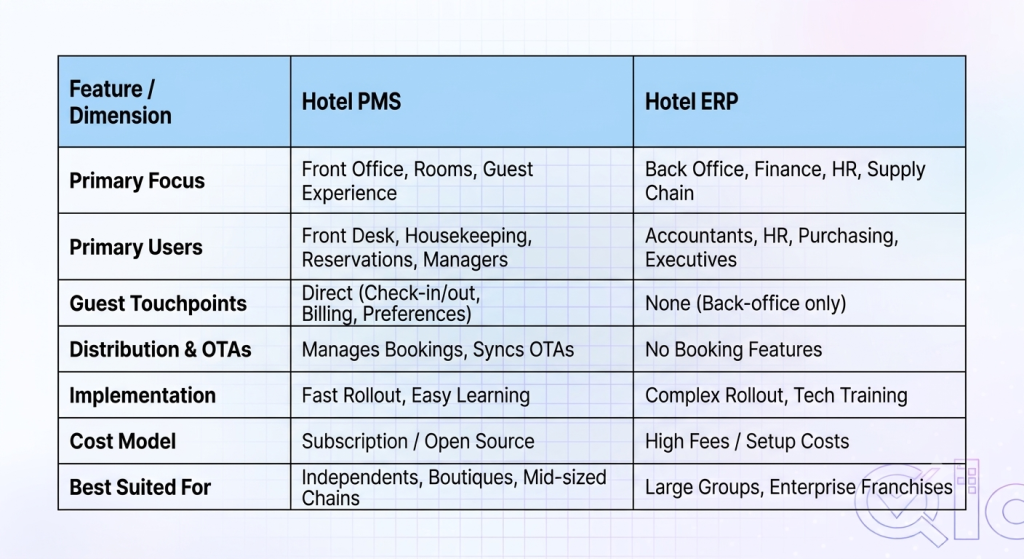
- Typical cost: PMS is priced per room; ERP is priced per module or entity
- Core focus: PMS handles guests and rooms; ERP handles finance and supply chain
- Daily users: PMS suits front desk staff; ERP suits accountants and HR teams
- Online Travel Agency (OTA) and booking sync: PMS manages channels directly; ERP has none at all
- Setup time: PMS rolls out in days; while ERP rollout takes several months
Seeing Hotel PMS or ERP laid out this way makes the choice much clearer. Match each column to what your hotel actually struggles with today.
How to Know If Your Hotel Needs an ERP
Buying a full ERP too early is a common and costly hotel mistake. Owners often pay for modules that sit unused while daily problems stay unsolved.
Use this checklist to judge your hotel’s real software needs honestly:
Signs a Hotel PMS like QloApps still fits you well:
- Property Operations: You run 1 to 5 properties and need one unified booking system.
- Direct Distribution: You want native channel management and direct web bookings.
- Fast Staff Onboarding: You need a system with good User Experience (UX) without a steep learning curve.
Signs a Hotel ERP is worth adding on top:
- Central Procurement: Bulk vendor orders, central purchasing, and inventory reorders across properties.
- Complex F&B Stock: Recipe costing, waste tracking, and central kitchen inventory transfers.
- Asset Management: Tracking equipment depreciation, maintenance schedules, and capital costs per site.
- Inter-Company Billing: Automated transfers of staff, shared services, and stock between locations.
- Enterprise HR: Managing multi-region shift scheduling, union rules, and localized labor laws.
This checklist solves most of the Hotel PMS or ERP confusion fast. Property count alone rarely tells the full story of what your hotel truly needs.
How QloApps Gives You the Best of Both Worlds
QloApps is a complete Hotel PMS built to grow alongside your hotel business easily. It combines front desk management, a booking engine, and a channel manager in one place.
It lets you customise room types, pricing rules, and guest workflows freely. This same flexibility carries over cleanly as you open new properties.
Its open-source code allows easy module integration for accounting and local tax tools. Hotels can add new features through add-ons without a costly ERP upgrade.
For most hotels weighing Hotel PMS or ERP, QloApps keeps working well past one hotel. It manages multiple properties from one dashboard without a costly early switch.
When Should You Integrate both PMS and ERP?
Large hotel chains eventually connect their PMS and ERP systems. The PMS sends room revenue and guest data straight into the ERP for finance.
The ERP then uses that data for payroll, supplier payments, and company reports. This saves accounting teams from typing the same numbers twice by hand.
So the Hotel PMS or ERP question is not always either/or. For enterprise hotel groups, an ERP simply completes what the PMS already started.
Conclusion
The best software choice depends on your property’s daily operational bottlenecks. Focusing on core workflows prevents costly mistakes and keeps your staff fast.
Choose a modern PMS if you run independent properties or small hotel groups. It eliminates booking errors, reduces OTA commissions, and streamlines check-ins.
Integrate an enterprise ERP only when managing multi-entity corporate finances. Pick the technology stack that fits your current scale and supports growth.
Get In Touch
Need help choosing the right software stack for your hotel? Our QloApps Team is here to guide your team every step of the way.
Contact us today for a free custom tech consultation. Let us build a lean, profitable system tailored to your property’s exact scale.

Be the first to comment.