
Financial forecasting has always been one of the hardest tasks for hotel CFOs. The hotel industry is constantly evolving, and nothing remains the same for long. Guest behavior shifts fast.
Travel patterns rise and fall without warning. Market demand can jump one day and drop the next. Because of all this, predicting the financial future of a hotel becomes a difficult and delicate job.
For many years, hotels used spreadsheets, manual calculations, and old data to predict their financial future.
These methods worked fine when the market was calm and stable. But today, the world is much more dynamic, and those old tools can no longer keep up.
This is where artificial intelligence becomes useful. AI helps CFOs look ahead with much more clarity.
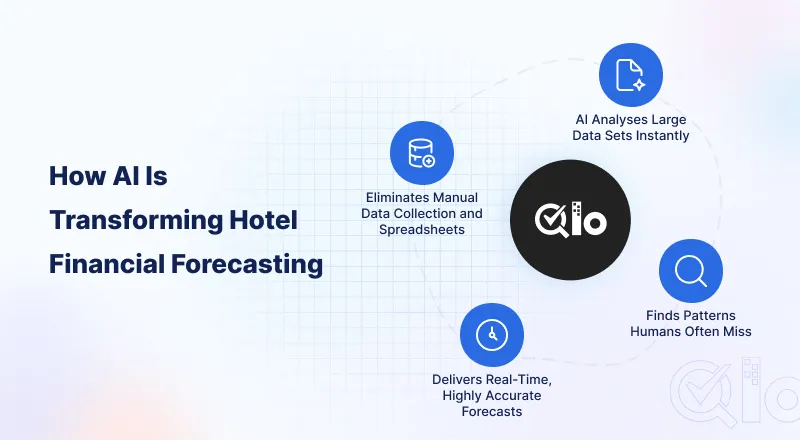
It can study huge amounts of data in seconds. It spots patterns that people often miss. And it creates accurate forecasts in real time.
Instead of spending hours collecting and checking numbers by hand, hotel finance teams can now use smart systems that learn, adapt, and improve on their own.
Why Traditional Forecasting Falls Short Today
The hospitality world has changed a lot in the last decade. Guest expectations are rising and changing faster than ever.
Booking channels have increased, and competition for travelers’ attention is now very strong.
Hotels must watch not only their own numbers but also many outside factors. These include hotel technology trends, customer opinions, local events, weather changes, and even global news.
Traditional forecasting tools cannot handle this heavy workload. They are slow, fixed, and rely on limited data.
For example, a spreadsheet cannot change itself when demand suddenly rises because of a festival, a wave of cancellations, or a competitor’s flash sale.
Finance teams often find themselves reacting too late simply because the tools they use cannot keep pace with the market.
AI removes these limitations. It studies patterns very quickly, finds hidden links in the data, and updates predictions instantly.
For CFOs, this means forecasting becomes a strategic task instead of a tiring manual effort.
How AI Is Changing the Way Hotels Predict Their Financial Future
AI changes financial forecasting by turning large and complex data into clear, useful insights.
Instead of looking only at past performance, it blends past and present information and predicts how these signals will shape the future.
One of the most important benefits of AI forecasting is improved demand prediction, allowing hotels to understand future occupancy through accurate analysis instead of guesswork.
AI looks at years of booking history, seasonal trends, local events, online travel searches, competitor prices, and even weather forecasts.
This creates a clear and constantly updated view of expected demand.
This affects almost every part of hotel finance. Better demand forecasts lead to better revenue predictions.
When CFOs know how many rooms will likely sell in the coming weeks or months, they can plan everything else with confidence—budgets, staffing, purchasing, promotions, and cash flow.
AI is also changing how hotels set prices.
Instead of using fixed rules or occasional manual updates, AI systems track market conditions in real time and recommend the best rate for each room, date, and type of guest.
CFOs can use these smart recommendations to help revenue managers and improve profit margins, even when the market is unpredictable.
On the expense side, AI does more than just estimate costs—it learns how hotel operations actually run.
It learns when staffing levels usually rise, when utilities peak, how occupancy affects housekeeping time, and when the kitchen requires more supplies.
With this knowledge, AI creates a realistic cost forecast that is aligned with predicted demand, not generic assumptions.
This allows hotels to cut unnecessary spending while maintaining service quality.
Cash flow forecasting is also easier with AI. Instead of manually tracking money coming in and going out, AI keeps an eye on financial activity all the time.
They predict when cash shortages might occur and suggest the best times to schedule payments, purchase inventory, or release funds for maintenance.
Another big advantage is scenario planning. AI can run many “what-if” scenarios and show how they affect revenue and costs.
A CFO can see what happens if demand suddenly drops, a new competitor opens nearby, or OTA commissions rise unexpectedly.
Instead of guessing, the finance team gets clear, data-based forecasts.
The AI Models Powering Modern Hotel Forecasts
Behind these features are different types of AI models working together. Time-series models look at past trends to predict future occupancy, average daily rates, and revenue.
Regression models show how outside factors affect performance. For example, they reveal how weather changes weekend bookings or how local events change the length of a guest’s stay.
Machine learning models continuously refine themselves with every new data point, becoming more precise over time.
Finally, pricing models study the market and competitors to suggest the best room rates at any time.
All of these models work behind the scenes, allowing hotels to forecast accurately without needing to understand the technical details.
What CFOs Need to Do to Implement AI Forecasting
Adopting AI does not require a massive digital transformation in hospitality.
It starts with ensuring that a hotel’s data systems—Property Management System, Channel Manager, POS, and accounting software—are clean and connected.
Once the data flow is stable, the next step is choosing an AI solution that fits the hotel’s scale and needs.
Many hotels opt for AI-enabled PMS or Revenue Management System platforms, while others prefer standalone forecasting tools.
Some larger hotel groups even build custom AI models tailored to their specific requirements.
Regardless of the approach, the goal remains the same: to centralize data, enable automated analysis, and produce real-time forecasts.
Training finance and revenue teams is very important. AI does not replace people; it helps them make better decisions.
When teams know how to read and use AI forecasts, they can act faster and with more confidence.
Over time, as AI forecasting continues to learn and the hotel refines its inputs, overall accuracy improves even further.
What CFOs Gain from AI-Driven Forecasting
For hotel CFOs, AI is extremely valuable. Forecasts become more accurate, which reduces the uncertainty that often makes financial planning difficult.
Decisions can be made faster because insights are available instantly, not just after weekly or monthly reports.
Profit margins improve due to optimized pricing and more controlled expenses. And perhaps most importantly, CFOs gain greater control over risk through enhanced scenario planning.
Hotels that embrace AI forecasting develop a stronger, more resilient financial strategy. They stay ahead of demand changes, respond quickly to market shifts, and operate with greater efficiency.
A Smarter Future for Hotel Finance
AI is changing the future of hotel finance. Tasks that once took days of manual work can now be done in minutes, with much higher accuracy.
For hotel CFOs who want to stay competitive in a fast-changing market, AI forecasting is no longer just a tool—it has become a necessity.
Get in Touch
QloApps is a free and open-source property management software that provides Property Management Software(PMS), Booking Engine, and Booking Website for your property.
You can download and install QloApps on your system or server.
If you have any further topics of discussion, please connect with our QloApps Support Team


Be the first to comment.