
Here is something nobody tells you when you open your first hotel in India. The thing that catches most new owners off guard is not a bad review or a slow season.
It is a compliance notice they were not expecting, for a rule they did not know existed.
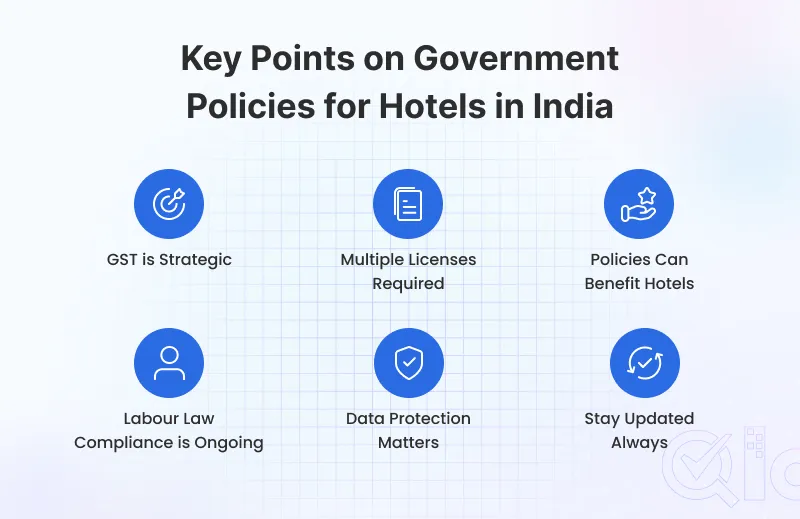
Government policies for hotels in India sit quietly underneath everything you do.
Your room pricing, your staff contracts, your guest data, your opening timeline — all of it is touched by regulation in some way.
Ignoring this does not make it go away. It just means you find out the hard way.
The good news is that none of this is impossible to understand. You just need to know where to look.
GST Rules Under Government Policies for Hotels in India
Let’s start with the most immediate one. Rooms priced below ₹7,500 per night attract 12% GST. Rooms at or above that number jump to 18%.
That gap is six percentage points, and it changes how you build your pricing model entirely.
Some smaller properties sit just below that threshold on purpose. It keeps the tax load lighter for guests and makes the listing look sharper on booking platforms.
That is not cutting corners — it is a legal and sensible pricing decision. But it only holds up if your actual margins were planned around that number from the beginning.
If you have not mapped this out properly, smart cash flow management is what turns a clever pricing strategy into one that actually survives month to month.
Licences Required Under Government Policies for Hotels in India
A lot of first-time owners assume there is one hotel licence to get, and they are done.
There is not. In India, you are dealing with multiple approvals from departments that do not communicate with each other and move at their own pace.
You need a trade licence from your municipal body. A fire safety certificate from a different authority altogether. An FSSAI licence if any food is served on the premises.
Many states also require separate tourism department registration before you can legally operate. Alcohol service adds a liquor licence on top of everything else.
Miss one of these during an inspection, and you are looking at penalties or a forced temporary closure.
Before you sign any property lease, spending time understanding what licences you need to open a hotel will save you months of painful back-and-forth later.
Some Government Policies for Hotels in India Actually Benefit You
People hear “regulation” and assume it means more cost and more paperwork. That is not always true.
Several state governments run active hospitality support programmes, particularly in regions trying to build up their tourism base.
Subsidised loans for infrastructure, stamp duty relief on property purchases, capital investment subsidies — these are all real and available in certain states.
Central schemes like Swadesh Darshan and PRASHAD have also pushed significant funding into pilgrimage and heritage travel corridors around the country.
If your property sits near one of those areas, that investment pulls more visitors into your region.
You are not spending anything on marketing, but you are benefiting from the footfall it creates. Most first-time owners never apply for any of this simply because they did not know it existed.
Labour Laws Affecting Hotels in India
India’s labour regulations apply to hotels fully and without exception.
Working hours, overtime pay, provident fund contributions, and proper employee records all need to be handled correctly across every department, every month.
The ongoing shift toward four consolidated labour codes is still uneven across states.
Some have adopted the new framework. Others are still running on older rules. That inconsistency creates genuine confusion, especially for owners managing their first team.
Hiring a local HR consultant who understands the hospitality sector is genuinely worth the cost at this stage.
Getting this wrong from the start creates disputes that damage both your finances and your reputation with staff.
Data Protection Has Real Teeth Now
India’s Digital Personal Data Protection Act is not just a headline. It changes what you are legally allowed to do with the information guests share with you.
Passport scans, card details, phone numbers — hotels collect a lot, and the rules around storing it are tightening.
This is especially relevant for properties moving to cloud-based property management systems that store guest records centrally.
Your software provider needs to be compliant. Your front desk team needs to understand what they can and cannot do with that data, day to day.
This is not a large-chain problem. A ten-room guesthouse collecting passport copies faces the same obligations as a two-hundred-room property.
Staying Informed Is Genuinely Part of the Job
Government policies for hotels in India shift more often than most business owners expect. GST rates get reviewed.
State tourism schemes open and close. New requirements appear sometimes with very little notice.
The owners who handle this consistently well are not smarter than everyone else. They just built a habit around it early.
Local hotel association membership. A hospitality-savvy accountant or legal advisor on call. Regular attention to government notifications that affect their category.
That routine takes maybe a few hours a month. The surprises it prevents can cost far more than that.
Conclusion
Understanding government policies for hotels in India is not optional — it is part of running the business.
These policies shape your pricing, your opening timeline, your staffing costs, and your legal exposure in ways that add up quickly.
Most of it is manageable once you understand what is actually in front of you.
The owners who stay ahead simply decide early that compliance is part of daily operations, not a separate problem to deal with later.
Get In Touch
If you are building your hotel operations and want a system that keeps your bookings, guest records, and billing organised from day one.
QloApps is a free, open-source hotel management platform worth exploring.
It covers property management, front desk operations, and guest data handling in one place.
You can download QloApps and get started at no software cost. For questions during setup or ongoing guidance, the QloApps support team is there to help.


Be the first to comment.