
Some travellers only want a place to rest for a few hours between flights, meetings, or long drives. Others may need a quiet space to work during the day.
Because of this shift, the traditional check-in and check-out model does not always match what guests are looking for.
Hotels that offer hourly bookings can meet this new demand and make better use of their rooms.
What Are Hourly Bookings?
It allows guests to book a hotel room for a few hours instead of staying overnight. In this model, the guest pays only for the time they use the room.
This option is helpful for business travellers, people with long layovers, or anyone who needs a short rest.
It is different from the usual hotel booking, where guests check in in the afternoon and leave the next morning. It gives more flexibility to both hotels and guests.
Why Hotels Lose Revenue Without Day-Use Options
Most rooms stay empty for several hours during the day, especially between check-out in the morning and check-in in the afternoon.
During this time, rooms generate no income, which is why flexible options like microstays and day-use bookings help hotels unlock revenue and fill idle hours.
There are also guests who want a room only for a short time, but they may look somewhere else if that option is not available.
Because of fixed check-in and check-out times, hotels miss these small but important booking chances. Over time, these missed hours can turn into a big loss in potential revenue.
How Hourly Bookings Increase Revenue
Monetizing Idle Inventory:
Many hotel rooms stay empty for a few hours during the day. These unused room hours are not earning any income for the hotel.
Using the hourly bookings add-on, the hotel can sell these rooms during that gap time, allowing for revenue-producing stays with a minimum of three to four (3-4) hours.
Instead of letting these unused room hours sit empty, hotels can find ways to use the time to create revenue.
Increasing RevPAR Without Adding Rooms
Hotels usually increase revenue by adding more rooms or raising prices. But hourly bookings offer another way.
A single room can be sold more than once in one day. For example, it can be booked for a few hours in the afternoon and again for an overnight stay.
This increases the total revenue earned from the same room. Without building new rooms or investing in expansion, hotels can improve their overall earnings.
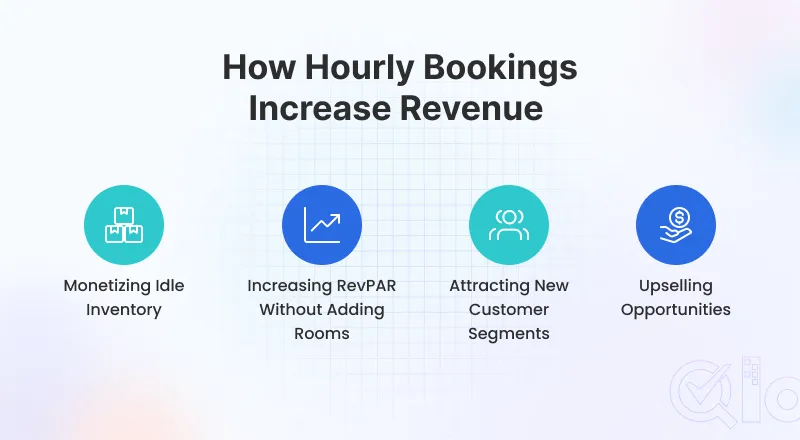
Attracting New Customer Segments
Business travellers can use a room on an hourly basis instead of waiting before their next meeting or during a layover between flights.
Travellers who are travelling for business would not book a full night’s stay; however, they are willing to pay to use it short-term.
When hotels offer flexible booking options, they are expanding their customer base and can obtain added revenue streams.
Upselling Opportunities
Short-stay guests often look for comfort and convenience. Hotels can offer extra services like meals, spa access, meeting rooms, or late check-out.
These add-ons increase the total spending per guest. Even if the booking is only for a few hours, the overall revenue can grow through these additional services.
This makes hourly bookings not just flexible but also profitable.
Smart Pricing Strategies for Hourly Stays
Smart pricing is very important for hourly stays. Hotels can create simple time packages like 3 hours, 6 hours, or half-day use.
The price should be lower than a full night but still profitable. During busy hours, the rate can be slightly higher, and during slow hours, hotels can offer better deals to attract more guests.
With the right pricing plan, hourly bookings can bring steady and extra income without affecting regular overnight sales.
Operational Tips for Smooth Management
It is important for the front desk team to be aware of all short-stay guests’ check-in and check-out times to ensure that they are able to provide these guests with excellent service.
In addition, a good property management system (PMS) and booking engine can help keep track of hourly reservations in a way that will be easy to understand and without confusion.
Conclusion
With hourly room reservations hotels can sell the same room several times throughout the same day.
Today’s modern traveler often does not need 24 hours in a hotel room.
With a successful pricing strategy and a well organized hotel operation, hotels may create additional revenue through hourly room reservations while having limited additional direct operating costs.
In addition, due to the rapidly evolving nature of the travel industry, flexible room reservation options are not only possible, but also a smart business decision.
Get In Touch
If you’re ready to elevate your hotel’s operations or have any questions, QloApps is here to assist!
Let’s collaborate to streamline your processes and enhance guest satisfaction.
Discover how QloApps’ Property Management System and Channel Manager solutions can simplify your operations and boost your revenue. Get in touch now!

Be the first to comment.